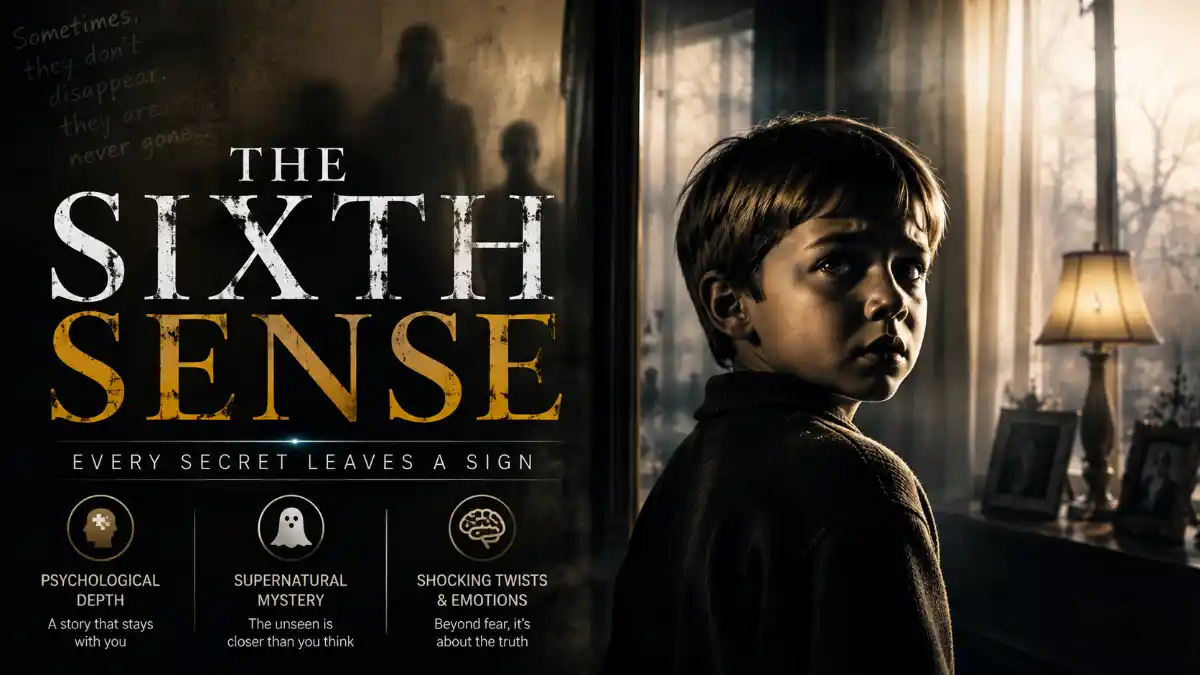

The Sixth Sense is the 1999 psychological thriller from M. Night Shyamalan that turned a quiet story about a child psychologist and a frightened nine-year-old into one of the most discussed twist endings in film history. Bruce Willis plays Dr. Malcolm Crowe, and Haley Joel Osment plays Cole Sear, a boy who says he can see and speak with the dead. What audiences don’t realize until the final scene is that the story has been hiding something about Malcolm himself all along, which is exactly what makes The Sixth Sense one of the most rewatched films of its decade.
The Ending Explained in 30 Seconds
Major spoilers below.
Malcolm Crowe has been dead since the film’s opening scene, when former patient Vincent Grey shot him before taking his own life. Malcolm doesn’t realize this and continues his work with Cole, believing he’s simply doing his job. Cole can see and speak with Malcolm because Cole sees dead people who don’t know they’re dead. In the final scene, a dropped wedding ring and his own gunshot wound force Malcolm to confront the truth, letting him say what he needs to say to his wife, Anna, before accepting his death.
Plot Summary
Malcolm Crowe, a respected child psychologist, is celebrating a career award with his wife when Vincent Grey, a former patient, breaks into their home, accuses Malcolm of failing him years earlier, and shoots him. The film then jumps forward to the following fall, where Malcolm begins treating Cole Sear, a withdrawn boy who reminds him uncomfortably of Vincent.
Cole is being bullied, hiding unexplained marks on his body, and clearly terrified of something he won’t name. His mother, Lynn, senses something is deeply wrong but can’t get her son to open up, and much of the film’s early tension comes from watching a parent try to reach a child who has learned that telling the truth only makes things worse. He eventually tells Malcolm the truth: he sees dead people who don’t know they’re dead. Rather than dismissing this, Malcolm – convicted by an old therapy recording that Vincent had the same ability – advises Cole to listen to what the ghosts need instead of fearing them.
Guided by the ghost of a girl named Kyra Collins, Cole retrieves evidence proving Kyra’s mother poisoned her, protecting her younger sister from the same fate. This subplot matters beyond its immediate resolution, because it’s the clearest proof within the story that Cole’s ability has real purpose rather than being purely a source of fear. Emboldened, Cole later confides in his mother, Lynn, proving his ability by describing details about her own childhood that only a deceased relative could have shared. Their relationship, strained for most of the film, is repaired just before the story’s final turn, giving Cole an ally who fully believes him for the first time.
When Did Malcolm Crowe Die?
Malcolm dies during Vincent Grey’s attack in the film’s opening scene. The main story involving Cole picks up the following fall, but every scene set after the shooting depicts events from the perspective of a man who has already died without realizing it. This is why the film’s opening minutes reward a second look: what plays as a tense home-invasion scene on a first viewing is, in hindsight, the exact moment the rest of the story pivots around.
Why Didn’t Malcolm Know He Was Dead?
Cole explicitly states the film’s rule: the dead often don’t know they’re dead, and they see only what they want to see. Malcolm’s fixation on his guilt over Vincent, his patience with Cole, and his effort to reconnect with Anna can be interpreted as the unresolved emotional business that keeps him from recognizing his own condition, though the film frames this through Cole’s dialogue rather than spelling out the exact mechanism. What’s directly shown is that Malcolm continues functioning exactly as he did in life – seeing patients, going home, trying to reach his wife – consistent with Cole’s description of how the dead behave.
This detail also explains why Malcolm’s storyline feels emotionally coherent rather than like a plot trick bolted onto the film after the fact. His entire arc, from the opening confrontation with Vincent to his final scene with Anna, is really the story of a man working through exactly the kind of unfinished business Cole describes, without either of them realizing that Malcolm fits his own diagnosis.
Did Cole Know Malcolm Was Dead?
What’s confirmed: Cole can see and speak with Malcolm because Malcolm is dead, consistent with Cole’s stated ability to perceive people in that condition. What’s not confirmed: whether Cole understood, from the start of their sessions, that Malcolm himself didn’t know he was dead. The film never has Cole state this directly. His line about ghosts not knowing they’re dead is delivered while he’s looking at Malcolm, which viewers commonly read as an indirect acknowledgment – but that reading is an interpretation of the scene, not something the script confirms outright.
This ambiguity is arguably intentional. If Cole understood Malcolm’s condition early on, his choice not to say anything fits the film’s larger idea that the dead need to reach their own realizations rather than being told the truth outright – the same pattern that plays out with Kyra and, eventually, with Malcolm himself.
Why Doesn’t Anna Talk to Malcolm?
Anna doesn’t respond to Malcolm throughout the film because she cannot see or hear him – she isn’t a medium like Cole, so from her perspective, Malcolm simply isn’t there. Scenes like their anniversary dinner, where Anna appears cold and distracted, initially read as marital tension. On a second viewing, they play very differently: Anna isn’t ignoring her husband – she has no idea he’s speaking to her at all.
This single misdirection does a lot of narrative work. It lets the film build an entire subplot about a marriage falling apart, only to reveal that the emotional distance was never really about the marriage at all – it was about a loss neither character had processed, for very different reasons.
Major Clues That Malcolm Was Dead
Shyamalan builds the twist on evidence that holds up once you know what to look for. Here’s how first-watch assumptions compare to what’s actually happening:
| Clue | First-Watch Interpretation | Meaning After the Twist |
| Anniversary dinner | Anna is distant because the marriage is struggling | She cannot see or hear Malcolm at all |
| Basement office door | Malcolm opens it the way anyone would | The scene conceals that Malcolm isn’t interacting with the door the way the audience assumes |
| Wedding ring | An easy detail to overlook | Malcolm isn’t wearing it, confirming he’s no longer living |
| Cole’s statement about ghosts | A description of his general ability | A line many viewers read as an indirect reference to Malcolm’s own condition |
| Malcolm’s gunshot wound | Never shown after the opening scene | Confirms he died from Vincent’s attack rather than recovering |
| Malcolm’s wardrobe | Ordinary continuity | The same coat and sweater appear in every scene, as though time stopped for him |
| No adult speaks to Malcolm directly | Unremarkable in isolation | Consistent with the fact that only Cole can perceive him |
| Color red in select scenes | Occasional visual detail | Recurs at several moments tied to Cole’s supernatural encounters, making it one of the film’s more noticeable visual patterns on a rewatch |
Read More: The Sixth Sense
The film never verbally explains the recurring use of red on screen, so its exact intended meaning remains a matter of viewer interpretation rather than a confirmed plot detail. Taken together, though, these clues form a second, quieter narrative running beneath the surface plot – one that only fully clicks into place once the ending recontextualizes everything that came before it.
What The Sixth Sense Ending Really Means
Beneath its ghost-story mechanics, the ending resolves two intertwined arcs of grief and communication. Malcolm’s guilt over Vincent drives his commitment to Cole, and it’s only by helping Cole accept his ability that Malcolm can accept his own death. Anna, meanwhile, has spent the film mourning a husband she doesn’t consciously know is gone – Malcolm’s final words to her, spoken while she sleeps, allow him to express what he needs to say before his spirit departs.
Cole’s arc mirrors this same idea from a different angle: his fear throughout the film comes not from the ghosts themselves but from not being believed. Once Malcolm and then Lynn accept his ability, that isolation lifts. The film’s broader theme – that unresolved emotional pain, more than death itself, is what keeps people from moving on – connects Malcolm, Kyra, and Cole into a single coherent idea rather than several separate ghost-story subplots. It’s this emotional throughline, more than the mechanics of the twist itself, that explains why the film continues to resonate with viewers who already know exactly how it ends.
Cast and Characters
| Character | Actor | Role in the Story |
| Malcolm Crowe | Bruce Willis | A psychologist unknowingly guiding Cole while working through his own unresolved death |
| Cole Sear | Haley Joel Osment | The boy whose ability to see the dead sets the entire plot in motion |
| Lynn Sear | Toni Collette | Cole’s mother, whose arc mirrors Malcolm’s in learning to trust what she can’t understand |
| Anna Crowe | Olivia Williams | Malcolm’s wife, grieving a loss she doesn’t consciously recognize |
| Vincent Grey | Donnie Wahlberg | The former patient whose violence sets the story’s central mystery in motion |
| Kyra Collins | Mischa Barton | A ghost whose case demonstrates the protective value of Cole’s ability |
Read More: The Sixth Sense
Osment received an Academy Award nomination for Best Supporting Actor for the role, and Collette received a matching nomination for Best Supporting Actress. Osment’s line about seeing dead people is ranked No. 44 on AFI’s list of the 100 greatest movie quotes in American cinema, a recognition that reflects how central the performances were to making the twist land emotionally rather than just narratively.
Production Background
Disney acquired Shyamalan’s spec script in a deal that also secured his position as director. Then-president of production David Vogel championed the purchase without full corporate approval, a decision reported to have contributed to his departure from the studio afterward; reported purchase figures vary by source, generally falling between $2.25 million and $3 million. Bruce Willis joined the project after an earlier film, Broadway Brawler, was shelved before production. The movie was filmed largely in Philadelphia, with cinematography by Tak Fujimoto and editing by Andrew Mondshein, who received an Academy Award nomination for his work – recognition that speaks to how much the film’s pacing and visual restraint contribute to the twist working as well as it does.
Reception, Awards and Legacy
As of this writing, the film holds an 86% critics’ score on Rotten Tomatoes. It received six Academy Award nominations, including Best Picture, Best Director, Best Original Screenplay, and Best Film Editing, and four BAFTA nominations, including Best Film. It won none of these but did receive the Nebula Award for Best Script.
Beyond its awards record, the film’s structure has become a reference point for how a twist ending can be built fairly, through consistent visual and narrative logic, rather than through a last-minute reveal with no supporting evidence. That reputation is a large part of why The Sixth Sense still gets discussed alongside modern psychological thrillers more than two decades after its release.
Frequently Asked Questions
Is Malcolm dead throughout The Sixth Sense?
Yes. Malcolm dies from Vincent Grey’s gunshot in the film’s opening scene, and every scene that follows shows him as a ghost who doesn’t yet realize his condition. This is the core mechanic behind the entire film’s structure.
When does Malcolm actually die? He dies
during Vincent’s attack in the opening scene, and the main story with Cole takes place the following fall. The film never gives an exact date, but the transition is marked clearly by the time jump.
Why doesn’t Malcolm know he’s dead?
Cole’s dialogue establishes that the dead often don’t know they’re dead and see only what they want to see. Malcolm’s guilt over Vincent and his strained marriage can be read as the unresolved business that fits this pattern, though the film doesn’t spell out the exact mechanism beyond Cole’s explanation.
Does Cole know Malcolm is dead?
The film confirms Cole can perceive Malcolm because Malcolm is dead, but it never explicitly confirms whether Cole recognized from the start that Malcolm himself didn’t know it. That reading is a common interpretation rather than a stated fact.
Why doesn’t Anna ever respond to Malcolm?
Because she cannot see or hear him. Unlike Cole, Anna cannot perceive the dead, so from her perspective, Malcolm is simply absent from their interactions throughout the film.
What does the color red represent in the film?
Red recurs at several moments connected to Cole’s encounters with the dead, making it one of the film’s most noticeable visual patterns on a rewatch. The film itself never explains this on screen, so its exact intended meaning remains open to interpretation.
How does Cole prove his ability to his mother?
Cole describes specific details about Lynn’s own childhood that he could only know if a deceased relative had shared them with him, which is what finally convinces her that his ability is real rather than a symptom of a disorder.
What role does the Kyra Collins subplot play in the story?
Kyra’s ghost leads Cole to evidence that she was poisoned by her mother, which he passes along to protect her younger sister. It’s the clearest example in the film of Cole’s ability being used to help someone rather than just frighten him.
Why is the twist in The Sixth Sense considered fair rather than a cheat?
Because the film plants consistent, visible evidence throughout, such as Anna’s one-sided conversations and Malcolm’s unchanging wardrobe, rather than relying on information withheld arbitrarily. Viewers can trace the twist back through the story once they know what to look for.
Does the ending explain what happens to Malcolm after he accepts his death?
No. The film ends with Malcolm’s spirit departing in a flash of light immediately after his final words to Anna, leaving what happens afterward unresolved and open to the viewer’s own interpretation.