
Sartorius muscle pain can occur around the front of the hip, along the thigh, or near the inner side of the knee. Because the sartorius crosses both the hip and knee and joins the gracilis and semitendinosus at the pes anserinus, pain in its region can overlap with several other muscle, tendon, bursal, nerve, and joint problems.
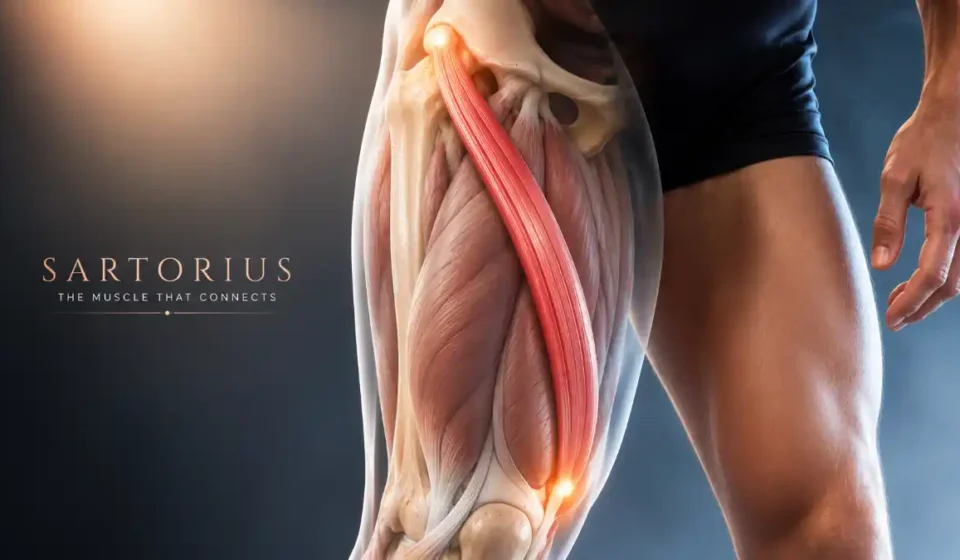
The sartorius runs from the anterior superior iliac spine (ASIS) across the thigh to the medial proximal tibia. It contributes to hip and knee movement and is innervated by the femoral nerve.
That anatomy is important because pain near the sartorius does not automatically mean the sartorius is injured.
The most useful clues are:
- Where the pain started
- Whether it appeared suddenly or gradually
- What activity triggered it
- Which movements reproduce it
- Whether swelling or bruising developed
- Whether weakness, numbness, or tingling is present
Sartorius muscle pain may result from acute overload, a muscle strain, repetitive training stress, an ASIS avulsion injury, or irritation around the pes anserine region. However, similar symptoms can come from the adductors, hip, medial knee, lumbar nerves, or other structures. Pain location alone cannot confirm a sartorius injury.
Where Is Sartorius Muscle Pain Located?
Because the sartorius travels diagonally from the front of the hip toward the medial knee, symptoms may occur at different points along its course.
Common areas include:
- Front of the hip near the ASIS
- Anterior thigh
- Medial or diagonal thigh
- Medial proximal tibia near the pes anserinus
The location can provide an important clue, but it is not enough to identify the injured structure.
For example, tenderness several centimeters below the medial knee joint line can occur in the pes anserine region, where the sartorius, gracilis, and semitendinosus tendons converge. A bursa lies beneath this tendon complex.
Similarly, anterior-thigh pain with neurological symptoms may point toward a nerve-related problem rather than a simple muscle injury.
Read More: Sartorius Muscle
What Causes Sartorius Muscle Pain?
Sartorius-region pain has several possible causes. The most useful distinction is whether symptoms began suddenly after a specific movement or gradually after repeated loading.
1. Sartorius Muscle Strain or Acute Overload
A muscle strain can occur when the tissue is exposed to a force or workload that exceeds its current capacity.
Potential triggers include:
- Sprinting
- Kicking
- Jumping
- Lunging
- Rapid acceleration
- Sudden deceleration
- Cutting or changing direction
- Unfamiliar high-intensity exercise
A sartorius strain becomes more plausible when there is a recognizable event followed by localized pain, tenderness, and reduced tolerance for movement.
However, the sartorius is not the only structure loaded during these activities. Larger thigh muscles, hip muscles, tendons, and joints may also be involved.
Therefore, exercise-related pain should not automatically be labeled a sartorius strain.
2. Repetitive Training Load
Pain may develop gradually after repeated activity rather than one obvious injury.
Possible situations include:
- Increasing running volume
- Adding more sprint sessions
- Increasing kicking frequency
- Returning suddenly to sport
- Increasing dance or jumping workload
- Changing training intensity
- Repeating movements that consistently aggravate symptoms
A sudden increase in workload can exceed the tissue’s recent capacity even when the individual exercise itself is not unusual.
This is why the change in training load can be more informative than simply asking which exercise was performed.
3. ASIS Avulsion Injury
An anterior superior iliac spine (ASIS) avulsion injury is particularly important in adolescents and young athletes whose skeletal development is not complete.
The sartorius and tensor fasciae latae attach around the ASIS. A sudden, forceful contraction can pull on the developing apophyseal attachment and produce an avulsion injury.
Typical circumstances include explosive movements such as sprinting.
Symptoms that make an ASIS injury more concerning include:
- Sudden pain directly over the ASIS
- Pain during sprinting or another explosive movement
- Immediate difficulty continuing the activity
- Local tenderness
- Reduced hip movement
- Difficulty walking normally
An avulsion injury is different from an ordinary muscle strain because the injury involves the bony attachment.
Suspected avulsion injuries should be assessed clinically rather than treated as routine muscle soreness.
4. Pes Anserine-Region Pain
The sartorius contributes to the pes anserinus, along with the gracilis and semitendinosus.
These tendons attach to the anteromedial proximal tibia, and the nearby pes anserine bursa lies beneath the tendon complex.
Irritation in this region may cause:
- Medial knee pain
- Tenderness below the medial joint line
- Pain with repeated knee loading
- Discomfort during activities such as running or climbing stairs
Importantly, pes anserine-region pain is not synonymous with sartorius muscle pain.
Clinical diagnosis can also be difficult because bursitis and tendon-related problems in this area may overlap, and imaging does not always show a clear abnormality.
Sartorius Muscle Pain vs. Other Causes
Medial thigh, anterior thigh, hip, and medial knee pain can have multiple causes.
| Possible source | Clues that may support it | Why it can resemble sartorius pain |
| Sartorius strain | Sudden overload with localized pain | Sartorius crosses the hip and knee |
| Adductor injury | Groin or medial-thigh pain | The regions overlap |
| Pes anserine disorder | Tenderness below the medial knee joint line | Sartorius is part of the pes anserine complex |
| MCL injury | Medial knee pain after trauma or valgus stress | Pain can occur close to the pes anserine region |
| Meniscal problem | Joint-line pain, catching, or locking | Medial knee pain is nonspecific |
| Hip-related disorder | Anterior hip or groin pain with hip movement | Sartorius originates near the hip |
| Femoral nerve problem | Pain with weakness or sensory changes | Neurological symptoms may be perceived in the thigh |
| Lumbar nerve-root problem | Radiating pain, numbness, tingling, or weakness | Symptoms can extend into the thigh |
Read More: Sartorius Muscle
This comparison is for understanding the differential diagnosis, not for self-diagnosing an injury.
What Does Sartorius Muscle Pain Feel Like?
Symptoms depend on the underlying problem.
Possible sensations include:
- Localized aching
- Pulling
- Tenderness
- Pain during specific hip or knee movements
- Pain with running or kicking
- Reduced exercise tolerance
- Reduced range of motion
- Pain-related weakness
- Swelling or bruising after a more substantial acute injury
A sudden pop, substantial bruising, marked weakness, or difficulty bearing weight makes a significant injury more concerning.
Gradual medial-knee pain without a clear muscle injury should broaden the differential rather than automatically being attributed to the sartorius.
What Movements Can Trigger Sartorius Pain?
The sartorius crosses both the hip and knee, so changing the position of either joint can affect its length and loading.
It contributes to:
- Hip flexion
- Hip abduction
- Hip external rotation
- Knee flexion
- Medial rotation of the leg when the knee is flexed
Because multiple muscles contribute to these movements, pain during one of them does not prove that the sartorius is injured.
A clinician may therefore compare different hip and knee positions and use resisted movements to determine which tissues reproduce the patient’s symptoms.
How Is Sartorius Muscle Pain Diagnosed?
There is no reliable home test that can confirm an isolated sartorius injury.
Diagnosis usually combines:
- Medical history
- Physical examination
- Movement and strength testing
- Assessment of alternative diagnoses
- Imaging when clinically appropriate
The goal is not simply to find a painful spot.
The goal is to determine:
Which structure best explains the complete pattern of symptoms?
What Questions May a Clinician Ask?
A clinician may ask:
- When did the pain begin?
- Was the onset sudden or gradual?
- Was there a specific movement or injury?
- Did you feel or hear a pop?
- Where was the pain first felt?
- Did swelling or bruising appear?
- Can you walk normally?
- Which movements make it worse?
- Has training volume recently increased?
- Is there numbness or tingling?
- Is there weakness?
- Does the knee lock or give way?
The answers can substantially change the likely diagnosis.
Read More: Sartorius Muscle
What May Be Examined?
Depending on the symptoms, examination may include:
Hip
- Range of motion
- Hip flexion
- Hip abduction
- Hip rotation
- Strength testing
- Palpation around the ASIS
Thigh
- Local tenderness
- Muscle strength
- Pain with resisted movement
- Flexibility and range of motion
Knee
- Medial proximal tibial tenderness
- Joint-line tenderness
- Range of motion
- Stability
- Meniscal testing when appropriate
Neurological Function
If symptoms suggest nerve involvement, the clinician may assess:
- Muscle strength
- Sensation
- Reflexes
- Distribution of symptoms
The sartorius receives motor innervation from the femoral nerve.
When Is Imaging Needed?
Mild soft-tissue pain does not automatically require imaging.
Imaging may be considered when:
- A significant muscle injury is suspected
- Symptoms are severe
- Symptoms persist despite appropriate management
- The diagnosis remains uncertain
- An avulsion injury is suspected
- Another structural problem needs investigation
Ultrasound can assess some superficial muscles and tendons, while MRI provides detailed visualization of muscles, tendons, bone marrow, and other soft tissues.
If an ASIS avulsion is suspected, imaging is particularly important because the suspected injury involves the bone attachment.
For pes anserine-region pain, imaging is not necessarily required for diagnosis, and clinical findings may be more important.
What Should You Do Initially for Sartorius Muscle Pain?
If the problem appears to be an uncomplicated acute soft-tissue injury, the initial goal is to reduce aggravating load while maintaining comfortable movement.
Reasonable early measures may include:
- Stop activities that clearly increase pain
- Avoid sprinting, jumping, or high-load movements temporarily
- Continue comfortable everyday movement
- Use ice if it provides symptom relief
- Manage swelling when present
- Avoid aggressive stretching of an acutely painful muscle
- Gradually reintroduce loading as symptoms improve
There is no need to apply a rigid “RICE for exactly 48–72 hours” rule to every case.
The appropriate approach depends on the actual injury.
Read More: Sartorius Muscle
Sartorius Muscle Pain Treatment
Treatment should follow the underlying diagnosis, not simply the location of the pain.
For example:
- A mild muscle strain may require progressive loading.
- An ASIS avulsion may require protected activity and orthopedic assessment.
- Pes anserine-region pain may require modification of aggravating activity and treatment of contributing factors.
- A neurological problem requires a different diagnostic and management pathway.
- A knee injury may require joint-specific treatment.
This distinction is one of the most important principles in treating sartorius-region pain.
Rehabilitation for a Sartorius Muscle Injury
For a confirmed uncomplicated muscle injury, rehabilitation is generally progressive.
A broad framework is:
1. Restore Comfortable Movement
Maintain movement that does not substantially aggravate symptoms.
2. Introduce Low-Load Activation
Gentle muscle activation can be introduced when tolerated.
3. Build Strength
Progressive resistance is added as pain and function improve.
4. Reintroduce Higher-Speed Loading
Depending on the activity, this may include:
- Jogging
- Running
- Acceleration
- Deceleration
- Direction changes
- Jumping
- Kicking
5. Return to Sport-Specific Activity
The final stage should reproduce the actual demands of the person’s sport or activity.
Rehabilitation after muscle strain is generally more useful when it is individualized and progressively loaded rather than based solely on a fixed number of rest days. A recent review of muscle-strain rehabilitation also highlights individualized progression and resistance training as important components of return-to-sport planning.
Should You Stretch the Sartorius?
Avoid aggressive stretching during an acute suspected muscle injury.
Later in rehabilitation, mobility work may be appropriate if:
- The diagnosis supports it
- The tissue is tolerating progressive loading
- Stretching does not significantly increase symptoms
Because the sartorius crosses two joints, hip and knee position can both influence its length.
But an important distinction is:
Feeling tight does not automatically mean the sartorius needs more stretching.
Tightness may accompany protective muscle activity, altered movement, or another underlying problem.
Read More: Sartorius Muscle
How Long Does Sartorius Muscle Pain Take to Heal?
There is no single healing time for sartorius muscle pain.
Recovery depends on what is actually injured.
A minor overload may settle relatively quickly, whereas:
- A significant muscle tear
- Tendon-related problem
- ASIS avulsion
- Knee injury
- Neurological condition
may require a substantially different recovery period.
Instead of relying on a universal number of days, look for functional improvement.
Useful recovery milestones include:
- Walking becomes comfortable
- Daily activities become easier
- Range of motion improves
- Strength returns
- Exercise becomes progressively more tolerable
- Sport-specific movements can be performed without significant symptom escalation
- Symptoms do not substantially worsen after increased activity
If progress repeatedly stalls, the diagnosis or rehabilitation plan should be reassessed.
Sartorius Pain or Pes Anserine Pain?
This distinction matters most when symptoms occur near the medial knee.
The pes anserinus is formed by the conjoined tendons of:
- Sartorius
- Gracilis
- Semitendinosus
The tendon complex attaches to the anteromedial proximal tibia, with a bursa beneath the tendons.
Therefore, tenderness in this region does not establish an isolated sartorius injury.
Pes anserine conditions can also overlap with other causes of medial knee pain. Research has found that clinical diagnosis of pes anserine tendinitis/bursitis can be challenging, reinforcing the importance of considering the broader differential.
Can Nerve Problems Mimic Sartorius Muscle Pain?
Yes.
The sartorius is supplied by the femoral nerve. A neurological problem can produce symptoms that extend beyond the muscle itself.
Possible warning features include:
- Numbness
- Tingling
- Altered sensation
- Significant weakness
- Reflex changes
- Pain extending beyond the expected muscle region
The lateral femoral cutaneous nerve is also relevant to upper-thigh symptoms, but it is a sensory nerve and does not provide motor innervation to the sartorius.
Therefore, neurological symptoms should not simply be treated as evidence of a tight or strained sartorius.
Can Lower-Back Problems Cause Pain Near the Sartorius?
Yes.
Pain perceived in the anterior thigh may sometimes originate from the lumbar spine or associated nerve roots rather than the thigh muscle itself.
This possibility becomes more important when thigh pain occurs with:
- Low-back pain
- Radiating pain
- Numbness
- Tingling
- Weakness
- Reflex changes
These findings require a broader assessment.
When Should You See a Doctor?
Seek professional medical assessment if you have:
- Severe or rapidly worsening pain
- Significant swelling
- Extensive bruising
- Difficulty bearing weight
- Major weakness
- Sudden ASIS pain after sprinting or explosive activity
- Suspected avulsion injury
- Numbness or tingling
- Persistent symptoms that are not improving
- Knee locking
- Significant knee instability
- Fever, redness, or unusual warmth around the painful area
These signs do not automatically indicate a serious condition, but they make self-diagnosis less appropriate.
Read More: Sartorius Muscle
How Can You Reduce the Risk of Sartorius-Region Problems?
There is no single “best sartorius exercise” that prevents every injury in this region.
A broader approach is more useful:
- Increase training volume gradually
- Avoid sudden spikes in intensity
- Develop overall hip and thigh strength
- Prepare specifically for sprinting, jumping, kicking, or cutting
- Warm up before high-intensity activity
- Progress sport-specific workloads gradually
- Allow adequate recovery
- Return progressively after an injury
The objective is to build sufficient overall movement capacity for the demands of the activity, rather than focusing exclusively on one muscle.
Sartorius Muscle Pain: Key Takeaways
Sartorius muscle pain describes a symptom, not a specific diagnosis.
The sartorius crosses the hip and knee and contributes to the pes anserine tendon complex distally. This anatomy explains why symptoms may occur around the front of the hip, thigh, or medial proximal knee.
The key points are:
- Pain near the sartorius does not prove that the muscle is injured.
- Acute overload can produce muscle pain or strain.
- Gradual pain may reflect training-load changes or another musculoskeletal problem.
- Sudden ASIS pain in a young athlete raises concern for avulsion injury.
- Medial proximal tibial pain may involve the pes anserine region.
- Numbness, tingling, weakness, or reflex changes require neurological consideration.
- Imaging is selected according to the clinical presentation.
- Rehabilitation should progress according to symptoms, function, diagnosis, and activity demands.
- There is no universal recovery timeline.
- Severe, persistent, traumatic, or neurological symptoms warrant professional evaluation.
Frequently Asked Questions
What does sartorius muscle pain feel like?
It may feel like aching, pulling, tenderness, or pain during certain hip or knee movements. These symptoms are not specific enough to confirm an isolated sartorius injury.
Where is sartorius muscle pain located?
It may occur around the front of the hip near the ASIS, along the anterior or medial thigh, or near the medial proximal tibia where the sartorius contributes to the pes anserine tendon complex.
What causes a sartorius strain?
A sartorius strain may occur when the muscle experiences a force or workload beyond its current capacity, particularly during sudden or forceful movements. Other structures can produce similar symptoms.
Can sitting cause sartorius muscle pain?
Sitting can be associated with hip or thigh discomfort, but persistent pain after sitting should not automatically be diagnosed as a sartorius injury. Other hip, lumbar, nerve, and musculoskeletal causes are possible.
Is sartorius pain the same as groin pain?
No. Groin pain has a broad differential that includes the adductors, hip joint, abdominal wall, and other structures. Sartorius-region pain can overlap with the area but is not synonymous with groin pain.
Can sartorius pain be mistaken for pes anserine bursitis?
Yes. The sartorius is one of the three tendons forming the pes anserinus, so pain near the medial proximal tibia can involve the pes anserine region rather than an isolated sartorius injury.
Should you stretch an injured sartorius?
Avoid aggressive stretching during an acute suspected muscle injury. Later mobility work may be appropriate when the tissue is tolerating progressive loading, and the exercise does not significantly aggravate symptoms.
Does every sartorius injury need an MRI?
No. Imaging is selected according to the clinical presentation. It becomes more useful when a significant tear, avulsion, persistent symptoms, diagnostic uncertainty, or another structural problem is suspected.
How long does sartorius muscle pain take to heal?
There is no universal recovery time. Recovery depends on whether the problem is a minor overload, muscle injury, tendon-related condition, avulsion, knee problem, or another diagnosis.
When should sartorius-region pain be medically evaluated?
Seek evaluation for severe or worsening pain, substantial bruising or swelling, inability to bear weight, marked weakness, neurological symptoms, suspected ASIS injury, persistent symptoms, knee locking, or significant instability.