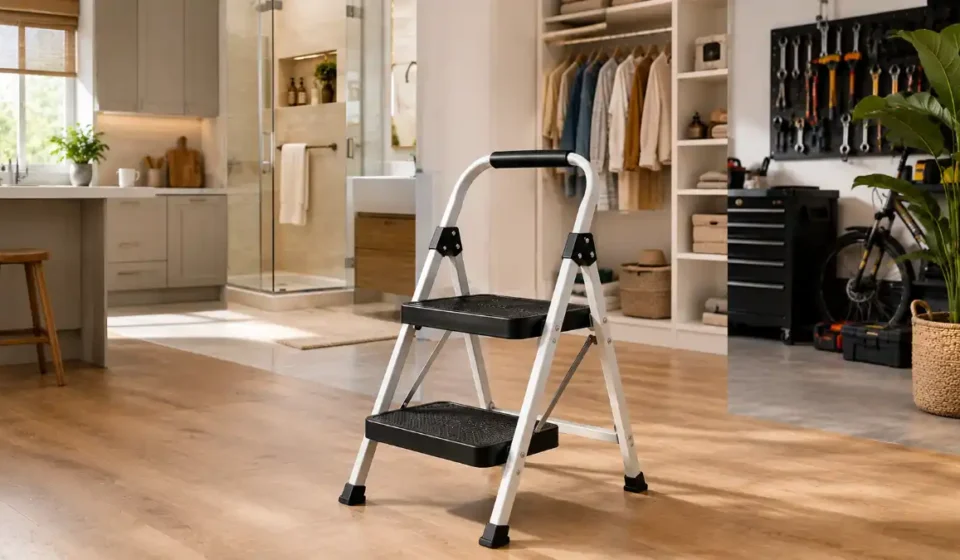
Step Stool for Every Room: How to Choose the Right Design for Kitchen, Bathroom, Closet, and Garage

A step stool can solve a simple problem-reaching a shelf, cabinet, storage bin, or other elevated surface-but the best design depends heavily on where you use it. A stool that works well in a dry closet may not be the best choice for a bathroom, while a compact kitchen model may be unsuitable for heavier workshop tasks.
Instead of choosing one product based only on height or appearance, evaluate the room itself. Floor condition, available space, frequency of use, storage, expected load, and the type of task all influence the right design.
The Room Changes the Buying Decision
Start with four questions:
- What are you trying to reach?
- What is the floor like?
- How much space is available?
- How often will the stool be used?
Then consider the user’s size, the total load, storage requirements, and whether children will have access to the product.
This room-first approach is more useful than saying that one material or style is automatically best for a particular room.
| Room | Main priorities | Useful design characteristics |
| Kitchen | Cabinet access and frequent movement | Stable base, easy handling, easy cleaning |
| Bathroom | Flooring and moisture conditions | Secure footing and suitable construction |
| Closet | Tight space and storage | Compact footprint or folding design |
| Garage | Durability and task demands | Appropriate capacity and stable construction |
| Laundry | Limited space and repeated access | Stable, easy-to-store design |
| Bedroom/living room | Occasional access | Compact and visually unobtrusive |
| Child-use area | Child-specific risks | Product designed specifically for children and used as instructed |
Read More: Step Stool
Kitchen: Prioritize Frequent, Controlled Access
Kitchens often contain storage above comfortable adult reach. That makes a compact stool useful for cabinets, shelves, and pantry organization.
The key issue is not simply height. Kitchens can also contain hard flooring, spills, narrow walkways, and frequent movement.
What to Look for in a Kitchen
A kitchen-oriented design should be:
- Stable on the intended floor
- Easy to move when necessary
- Simple to clean
- Appropriate for the user’s total load
- Easy to store without creating a trip hazard
- Tall enough for the intended cabinet or shelf
If the stool is frequently moved, lightweight construction can be convenient, but convenience should not replace stability.
Kitchen Placement Matters
Avoid setting up a stool where an open cabinet door, appliance, loose mat, or nearby object interferes with the user’s footing.
Move obstacles before climbing. If the task requires substantial sideways reaching, reposition the stool instead of leaning farther.
Bathroom: Floor Conditions Matter More Than Material Labels
Bathrooms deserve special attention because floors may become wet or slippery.
A common mistake is to assume that a water-resistant material automatically makes a stool suitable for bathroom use. It does not.
The more important questions are:
- Does the stool remain stable on the intended floor?
- Are the feet intact?
- Is the standing surface secure?
- Does the manufacturer permit this type of environment?
- Can the product be kept clean and dry as required?
- Is there enough clear floor space to position it safely?
Bathroom Step Stool Checklist
Before use:
- Remove water from the immediate floor area when practical.
- Keep loose bath mats or other obstacles away from the setup.
- Check that all feet contact the floor.
- Make sure the stool does not rock.
- Follow the manufacturer’s instructions concerning moisture and cleaning.
- Do not use the stool if its feet or standing surface are deteriorated.
A bathroom is therefore a good example of why environment-specific selection matters more than a simple material stereotype.
Closet: Compactness and Storage Become More Important
Closets often have limited floor space and narrow access paths.
A large, permanently positioned product may become an obstacle. A compact or folding design can be useful when the stool needs to be removed after each use.
For High Closet Shelves
Choose a height that lets you reach the shelf without excessive stretching.
If you have to lean outside the stool’s stable position, step down and move it closer. Never solve a height problem by standing on an unsafe object placed on top of the stool.
For frequent closet organization, consider where the stool will be stored. A product that is technically suitable but difficult to retrieve may encourage unsafe improvisation.
Garage and Workshop: Match the Product to the Task
Garages and workshops can place greater demands on an access product.
Floors may be uneven, dusty, oily, or cluttered. Tasks may also involve tools or materials that make maintaining balance more difficult.
Before Using a Stool in a Garage
Check:
- Floor condition
- Available working space
- Lighting
- Total load
- Product condition
- Whether you need both hands
- Whether the task creates a balance problem
If the work requires significant force, extended reaching, heavy loads, or prolonged elevated work, reconsider whether a simple stool is the correct access equipment.
A workshop task can require a different type of ladder or platform designed for the working conditions.
Read More: Step Stool
Laundry Area: Stability and Easy Storage
Laundry rooms commonly combine limited floor space with shelves, cabinets, and appliances.
A suitable product should be easy to position without interfering with doors or appliances.
Before climbing, make sure:
- The floor is clear.
- Appliance doors cannot interfere with the stool.
- The stool is positioned on a suitable surface.
- The user’s movement will not be restricted by surrounding equipment.
- The product can be stored safely when not in use.
Bedroom and Living Areas: Occasional Use Still Requires Proper Setup
A small stool may be used to reach shelves, storage furniture, curtains, or other household items.
Because these areas often have rugs and furniture nearby, positioning matters.
Do not assume that carpet or a rug automatically creates a stable foundation. Check that the product sits securely according to its instructions.
When finished, store the stool where it will not become an obstacle or an attractive climbing object for children.
One Stool for Every Room-or Several?
One versatile product can be convenient, but it is not always the best solution.
A household may benefit from different designs when:
- One room has unusually limited space.
- A bathroom has different floor conditions.
- Garage tasks require a different capacity or design.
- One user needs a different standing height.
- The product is used frequently in one location.
- A folding design is useful in one room but unnecessary in another.
The right question is not “Can one stool technically work everywhere?” It is “Can the same product be positioned and used safely in every intended environment?”
How to Compare Rooms Before Buying
Use this quick decision framework:
| Question | Kitchen | Bathroom | Closet | Garage |
| Frequent use likely? | High | Medium | Medium | Variable |
| Floor condition needs special attention? | Yes | High | Yes | High |
| Storage space important? | Yes | Yes | High | Variable |
| Cleaning important? | High | High | Medium | Medium |
| Load/task demands may vary? | Medium | Low–Medium | Low–Medium | High |
Read More: Step Stool
The table is a decision aid, not a safety rating. Actual requirements depend on the product and task.
Folding vs. Fixed by Room
A folding design is often useful when storage is a major concern.
A fixed design can be convenient when the product remains in one place and is used frequently.
Before choosing a folding model, inspect the hinges and locking mechanism. The product should be completely opened and securely locked according to its instructions before use.
The choice should therefore be driven by the room’s workflow rather than the assumption that folding is always better.
What Every Room Has in Common
Regardless of location, a step stool should be appropriate for the intended task and used on a suitable surface.
Important checks include:
- Correct load rating
- Appropriate standing height
- Secure feet
- Sound construction
- Suitable standing surface
- Reliable locks on folding models
- Clear surrounding area
- No visible structural damage
For workplace applications, OSHA requires inspection for visible defects and specifies requirements for ladder and stepstool use. Its workplace definition of a stepstool is also specific to the regulatory context and should not be treated as a universal consumer-product definition.
Special Consideration: Children’s Tower Stools
Children’s kitchen towers are not simply smaller versions of adult household stools.
They have different design and supervision considerations, particularly because children may move unpredictably and may interact with openings, barriers, and elevated platforms differently from adults.
Current CPSC recalls demonstrate why parents should check product-specific safety information rather than assuming a tower is safe because it looks sturdy.
For example, CPSC recalled Boon PIVOT collapsible toddler tower stools in July 2026 after reports that the towers could become unstable and tip over. The recall covered 116,908 units in the United States and called for consumers to stop using affected products until repaired.
CPSC also announced July 2026 recalls involving Woodure toddler kitchen towers and HARPPA Nordi toddler towers because of collapse, tip-over, and entrapment hazards.
If you own a children’s tower, search the exact brand, model, and recall information rather than relying on a general safety article.
Inspect the Product Based on the Room
Room conditions can accelerate wear or reveal problems that are easy to overlook.
Kitchen
Check for:
- Food or cleaning residue
- Loose feet
- Damaged standing surfaces
- Hinge problems
Bathroom
Pay particular attention to:
- Deteriorated feet
- Slippery surfaces
- Moisture-related damage
- Cleaning-product buildup
Closet
Look for:
- Loose hardware
- Cracks
- Worn feet
- Damage caused by repeated storage and movement
Garage
Inspect for:
- Oil or chemical contamination
- Bent components
- Damaged feet
- Excessive wear
- Structural damage
If the product is defective, do not continue using it simply because the damage appears minor.
Read More: Step Stool
When a Room Is Not Suitable
Sometimes the problem is not the stool but the environment.
Do not use the product when:
- The floor is unstable or unsuitable.
- There is insufficient space to position it correctly.
- You cannot maintain a stable working position.
- The product is damaged.
- The required load exceeds its rating.
- The task involves unsafe reaching.
- You would need to place it on another object to gain height.
The correct response is to change the setup or select different equipment-not improvise.
Frequently Asked Questions
What is the best step stool for a kitchen?
Choose one with an appropriate height, load rating, stable footing, easy handling, and a design that fits the kitchen’s available floor and storage space.
Can I use the same stool in the kitchen and bathroom?
Potentially, but only if the product is suitable for both environments and can be positioned securely on each floor. Bathroom conditions require particular attention to traction and moisture.
What type of stool is best for a closet?
A compact or folding model can be convenient when floor and storage space are limited. Choose enough height to reach shelves without excessive stretching.
Are folding stools good for small rooms?
They can be useful when storage space is limited. However, the folding mechanism must be fully opened and locked before use.
Is plastic better for bathrooms?
Not necessarily. Material alone does not determine suitability. Floor traction, product design, condition, instructions, and moisture suitability all matter.
Can I use a household step stool in a garage?
Only when its design, capacity, condition, and intended use are appropriate for the garage task and floor conditions.
Are children’s kitchen towers safe?
Safety depends on the specific design, condition, instructions, supervision, and product history. Check current recall information for the exact model.
Should I keep a step stool in every room?
Not necessarily. Multiple products can be useful when rooms have substantially different space, height, or environmental requirements, but one appropriately selected product may be sufficient for some households.
Can a stool be used on carpet?
Do not assume every stool is suitable for every carpet or rug. Follow the manufacturer’s instructions and verify that the product remains stable and fully supported.
Where should I store a step stool?
Store it where it is protected from damage and does not obstruct walkways. Children’s products should be stored according to the manufacturer’s safety instructions and kept away from unsupervised access when appropriate.