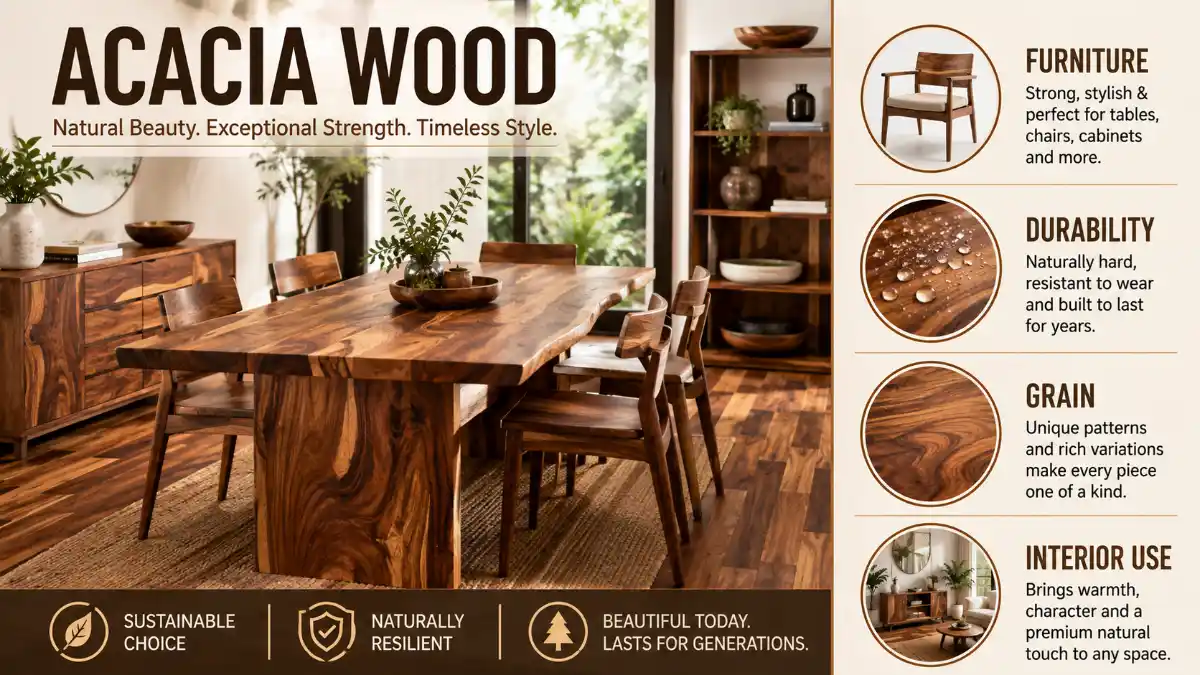

This hardwood is a popular choice for furniture, dining tables, benches, cutting boards, flooring, and outdoor pieces because it can combine attractive grain with useful hardness and practical durability. But the material is not one uniform product: the name covers many species, and their density, hardness, appearance, and decay resistance can differ significantly. That matters when you are deciding whether acacia wood furniture is right for a bedroom, dining room, kitchen, or patio.
This guide explains where acacia wood works best, what its real pros and cons are, how it compares with teak, and how to care for it without relying on vague claims about “maintenance-free” wood.
What Is Acacia Wood?
The timber comes from trees in the large Acacia group, commonly known as wattles in Australia. The genus contains hundreds of species, and wood properties can vary substantially from one species to another. For example, Acacia mangium has a listed Janka hardness of 1,430 lbf, while Australian blackwood (Acacia melanoxylon) is listed at 1,160 lbf. Those figures show why a single hardness number should never be treated as the specification for every piece sold under this trade name.
The species also differ in appearance. Australian blackwood can show golden to reddish-brown tones, contrasting bands, and wavy or curly grain. Other acacia woods may be darker, lighter, heavier, or more uniform. In practical terms, the species, board quality, construction, finish, and moisture exposure all matter when judging a finished product.
Is Acacia Wood Good for Furniture?
Yes. Acacia wood can be an excellent furniture material when the species, construction, finish, and intended location match the job. It is especially attractive for buyers who want a hard, visually distinctive hardwood without automatically moving into premium-priced teak.
Furniture made from this timber is commonly chosen for dining tables, coffee tables, benches, consoles, cabinets, bedroom furniture, and other solid-wood pieces. Its grain variation gives each board character, while the hardness of many commonly used species helps the surface handle normal household wear.
The important qualification is that “acacia” is a broad trade category rather than a promise of identical performance. A well-made table from a suitable species can be very durable, while a poorly dried or poorly finished piece can develop problems regardless of the wood name.
Acacia Wood by Room: Where It Works Best
Different rooms place different demands on furniture. Instead of asking whether acacia wood is simply “good,” match the material to the environment.
Living Room
This timber works well for coffee tables, side tables, TV consoles, shelving, and accent furniture. The grain can become a visual feature, particularly on large solid-wood surfaces.
For everyday indoor use, the biggest advantages are surface hardness, appearance, and relatively straightforward care. Keep the furniture away from intense heat and avoid allowing water to sit on the surface for long periods.
Bedroom
This furniture can be a strong choice for bed frames, dressers, nightstands, and wardrobes. Its substantial feel suits pieces that are intended to remain in place for years.
Because wood responds to changes in moisture, stable indoor conditions are helpful. Avoid placing solid acacia wood directly beside a radiator, heater, or other strong heat source, and use coasters or mats where moisture or heat is likely.
Dining Room
A dining table is one of the strongest use cases for this timber. Tables have to tolerate daily contact, spills, plates, chairs, and repeated cleaning, so a reasonably hard hardwood makes practical sense.
Dining tables made from this timber also benefit from natural variation. Rather than looking identical from board to board, the grain can include contrasting tones, knots, and patterns. Buyers who prefer a highly uniform surface should inspect the actual tabletop or product photographs carefully before purchasing.
Kitchen
This timber appears in cutting boards, serving boards, bowls, and utensils as well as furniture. For a cutting board, the important issue is not simply that the material is acacia wood. The board should be designed and finished for food contact, and it should be maintained according to the manufacturer’s instructions.
Hand-washing and prompt drying are generally safer for wooden cutting boards than prolonged soaking or dishwasher exposure. Food-contact products should not be treated with a random furniture finish.
Patio and Outdoor Spaces
Acacia wood outdoor furniture can work well, but outdoor exposure changes the maintenance equation. Sun, rain, humidity, temperature swings, and standing water can all accelerate surface weathering and dimensional movement.
A covered balcony, porch, or shaded patio is generally a more forgiving environment than a completely exposed yard. If the furniture is exposed to weather, follow the manufacturer’s finishing and care instructions, improve drainage, keep water from pooling, and consider covers or sheltered storage when practical.
The surface can develop a gray or silver appearance outdoors as it weathers. That color change is not automatically evidence that the furniture has failed. The bigger concern is whether moisture management, joints, finish, and wood condition are being maintained properly.
Read More: Acacia Wood
Acacia Wood Pros and Cons
The best way to evaluate this material is to separate genuine strengths from claims that depend on the particular product.
Pros of the Material
- Attractive natural variation: Acacia wood can range from golden and honey tones to deeper brown shades, with straight, wavy, curly, or figured grain depending on species and board.
- Good hardness in many species: Commonly sold acacia species can provide useful resistance to everyday dents and wear. Janka values, however, vary by species.
- Distinctive furniture appearance: Large acacia wood slabs and tabletops can create a strong natural focal point without requiring an elaborate decorative pattern.
- Versatile applications: Acacia wood is used for furniture, flooring, boards, utensils, and outdoor products.
- Potentially strong value: Compared with premium outdoor timbers such as teak, acacia wood can offer an appealing balance of appearance, performance, and purchase price, although prices vary by species, construction, and market.
- Repairable and refinishable in many furniture designs: Solid acacia wood can often be sanded and refinished when the construction and existing finish allow it.
Cons of Acacia Wood
- Species variation: “Acacia” does not tell you the exact density, hardness, or durability of a product.
- Moisture movement: Like other solid woods, acacia wood expands and contracts as moisture conditions change.
- Outdoor maintenance: Unprotected exposure to weather can accelerate fading, surface checking, finish failure, and other forms of weathering.
- Weight: Some acacia wood products are relatively substantial, which can be an advantage for stability but a disadvantage when moving furniture.
- Finish dependence: A protective finish can improve stain and moisture resistance, but the finish itself eventually needs attention.
- Quality varies by construction: A thick solid-wood top with well-built joinery is a different proposition from a thin veneer or poorly assembled product merely marketed as acacia.
Acacia Wood Durability: What Actually Determines It?
Durability should not be judged from the species name alone. Durability has several dimensions: resistance to dents and wear, resistance to moisture-related movement, resistance to decay, and the ability of the finished furniture to withstand its environment.
Janka hardness is useful for comparing resistance to indentation, but it is not the same thing as outdoor decay resistance. The Wood Database, for example, lists Acacia mangium at 1,430 lbf and Australian blackwood at 1,160 lbf, illustrating the variation within the group. It also rates Australian blackwood as moderately durable regarding decay resistance while noting susceptibility to insect attack.
That distinction matters. A hardwood is not automatically the best wood for an uncovered patio, and a softer wood is not automatically a poor indoor furniture material.
For outdoor furniture made from this timber, construction and exposure are just as important as the timber itself. Water trapped at joints, poor drainage, direct weather exposure, damaged finish, and repeated wet-dry cycles can shorten the useful life of furniture.
Acacia Wood vs Teak: Which Is Better?
The teak comparison is not a simple winner-versus-loser comparison. Teak has a well-established reputation for outdoor durability, while acacia wood can offer strong performance and value when properly selected and maintained.
Teak is the more predictable choice for buyers who want naturally durable timber for demanding outdoor exposure with relatively low maintenance. The Wood Database lists teak at about 1,070 lbf Janka hardness and describes its heartwood as very durable in decay resistance.
This material can make more sense when appearance, price, and value matter and the furniture will be used indoors or in a protected outdoor setting. Some acacia species are harder than teak, but hardness alone does not make them more decay-resistant.
| Comparison | Acacia Wood | Teak |
| Species consistency | Varies widely by species | More consistent as a recognized timber species |
| Surface hardness | Varies; some species are harder than teak | About 1,070 lbf Janka for teak |
| Outdoor decay resistance | Depends strongly on species and conditions | Heartwood is highly regarded for decay resistance |
| Best fit | Indoor furniture and protected outdoor use | Demanding outdoor applications |
| Maintenance | Depends on finish and exposure | Generally lower maintenance for weathered outdoor use |
| Appearance | Wide range of grain and color | Usually golden to medium brown, darkening with age |
| Buying priority | Identify species, construction, and finish | Verify genuine teak and construction quality |
Read More: Acacia Wood
If you are furnishing a covered patio, this material can be a sensible value choice. If the furniture will remain fully exposed year-round and you want the material itself to provide a high level of natural decay resistance, teak deserves serious consideration.
Acacia Wood Care: Indoor and Outdoor Maintenance
Good care is mostly about controlling moisture, protecting the finish, and responding to wear before it becomes a larger problem.
Indoor Acacia Wood Care
For indoor furniture made from this timber:
- Dust with a soft, dry or slightly damp cloth.
- Wipe spills promptly rather than allowing liquid to sit.
- Use coasters, placemats, and trivets where appropriate.
- Keep furniture away from strong heat sources.
- Avoid soaking the surface during cleaning.
- Follow the manufacturer’s instructions for polishing, oiling, or refinishing.
- Inspect the finish periodically for dullness, scratches, or areas where moisture is beginning to penetrate.
Do not assume that every piece of acacia wood needs oil every few months. The correct maintenance schedule depends on the finish and the manufacturer’s instructions. Some finished indoor furniture may require little more than routine cleaning.
Outdoor Acacia Wood Care
Outdoor furniture made from this timber needs more attention because weather continually stresses the surface.
- Clean dirt and spills with a method suitable for the existing finish.
- Allow the furniture to dry thoroughly.
- Keep standing water away from the surface and joints.
- Use a suitable outdoor finish when the manufacturer recommends one.
- Recoat according to the product instructions rather than following a fixed calendar.
- Use covers or sheltered storage when severe weather makes exposure unnecessary.
- Check screws, joints, feet, and end grain periodically for signs of movement or moisture damage.
If you prefer the original brown or golden appearance, a compatible exterior finish can help slow the visual weathering process. If you prefer a natural weathered look, you may allow the surface to gray while continuing to protect the furniture from excessive moisture and structural damage.
How to Buy Good Acacia Wood Furniture
The wood label is only the starting point. Before buying acacia wood furniture, check these details.
Ask What Species Is Used
A retailer that identifies the species gives you more useful information than a listing that says only “acacia.” Different species have different physical properties. Acacia mangium and Australian blackwood, for example, have different published hardness and density figures.
Check Solid Wood vs Veneer
“Acacia furniture” can describe solid timber, veneer over another material, or a combination of materials. None is automatically wrong, but they behave differently and should not be treated as equivalent.
Inspect Joinery
Look closely at table legs, corner joints, drawer construction, hardware, and connections between large panels. Good joinery can matter as much as the timber species in determining how a piece performs over time.
Ask About the Finish
For outdoor furniture, find out whether the product is factory-finished, unfinished, or designed to weather naturally. Ask which maintenance products the manufacturer recommends.
Consider the Environment
A beautiful acacia wood table can be the wrong purchase if it will sit in constant rain with no protection. Conversely, paying a large premium for highly weather-resistant timber may make little sense for a dining table kept in a climate-controlled room.
Acacia Wood Uses Beyond Furniture
Uses extend beyond tables and chairs. Depending on species and product design, acacia timber is used for flooring, cutting boards, serving pieces, decorative objects, turned goods, and other wood products.
Its appeal comes from a combination of visual character and useful mechanical properties, but the same rule applies across these applications: the exact species and manufacturing process matter.
For flooring, look at hardness, dimensional stability, finish, and installation requirements rather than relying only on the word “acacia.” For cutting boards, prioritize a purpose-made food-contact product and follow its cleaning and conditioning instructions.
Is Acacia Wood Sustainable?
It is too broad to call all acacia wood automatically sustainable. Sustainability depends on the species, plantation or forest source, harvesting practices, supply chain, and applicable certification.
The useful question when shopping is not simply “Is acacia wood sustainable?” but “Where did this particular wood come from, and can the seller document its source or certification?”
If responsible sourcing is important to you, look for credible sourcing information and recognized certification where available. Avoid assuming that a fast-growing species automatically means every product made from it has a low environmental impact.
Who Should Buy Acacia Wood Furniture?
This material is a strong choice if you want:
- Distinctive natural grain and color variation
- Solid-wood furniture for normal indoor use
- A durable surface for dining and everyday living
- A potentially strong-value alternative to premium timbers
- Outdoor furniture for covered or partially protected spaces
- A material with many furniture and household applications
You may want to look elsewhere if you need completely maintenance-free furniture for severe outdoor exposure or if you want extremely predictable properties across every piece. In those situations, a more consistently specified outdoor timber or a non-wood material may better match your priorities.
Frequently Asked Questions
Is acacia wood good for furniture?
Yes. Acacia wood can be an excellent furniture material because many species offer good hardness, attractive grain, and useful durability. The exact performance depends on the species, construction, finish, and environment.
Is acacia wood good for outdoor furniture?
Yes, particularly for covered or partially protected outdoor spaces. Fully exposed furniture needs appropriate construction, finishing, drainage, and regular care because weather can accelerate surface and moisture-related deterioration.
How durable is acacia wood?
Acacia wood durability varies by species. Janka hardness can differ significantly across acacia species, and hardness measures resistance to indentation rather than decay resistance. The Wood Database lists 1,430 lbf for Acacia mangium and 1,160 lbf for Australian blackwood.
Is acacia wood better than teak?
Not universally. Teak is generally the safer choice for demanding, fully exposed outdoor conditions because its heartwood has very high decay resistance. Acacia wood can provide excellent value for indoor furniture and protected outdoor applications.
Does acacia wood crack easily?
Acacia wood can develop checks or cracks when moisture changes are severe, the wood is poorly dried, or outdoor exposure is harsh. Good construction, suitable moisture conditions, and appropriate finishing can reduce the risk but cannot eliminate natural wood movement.
Does acacia wood need to be oiled?
Not every piece does. The need for oil depends on the existing finish, product design, and intended appearance. Outdoor furniture may need a compatible protective finish, while many finished indoor pieces only need routine cleaning.
Can acacia wood be used for cutting boards?
Yes, acacia wood is used for cutting boards. Choose a product specifically made for food contact, follow the manufacturer’s care instructions, avoid prolonged soaking, and do not apply an unsuitable furniture finish to the cutting surface.
Does acacia wood turn gray outdoors?
It can. Outdoor exposure to sunlight and weather can change the surface color of acacia wood, often producing a gray or silver appearance. This is a form of weathering and does not by itself mean the furniture is structurally failing.
How can I tell whether acacia wood furniture is good quality?
Check the stated species, solid wood or veneer construction, joinery, panel quality, finish, hardware, and intended-use instructions. For outdoor furniture, also check whether the manufacturer specifies a suitable finish and weather exposure.
What should I check before buying acacia wood furniture?
Check the species, construction, dimensions, finish, maintenance requirements, intended indoor or outdoor use, warranty or care instructions, and the seller’s sourcing information if sustainability matters to you. The word “acacia” alone is not enough to predict the performance of a specific piece.