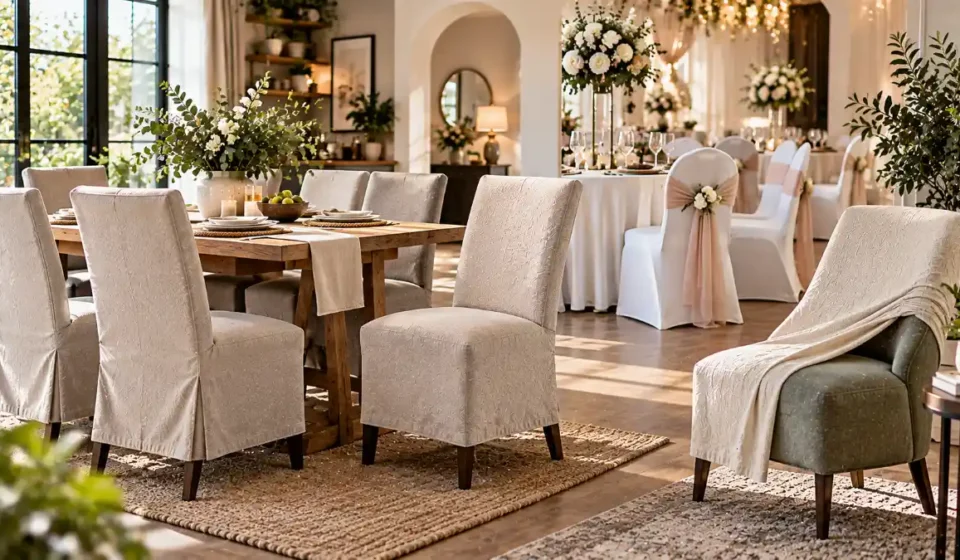

Choosing the right chair covers is less about finding one universal product and more about matching the cover to the chair, fabric, level of use, and setting. A dining chair used every day needs different protection from a chair prepared for a wedding reception, while an accent chair may need a decorative update rather than full coverage. The best choice starts with the chair itself and the job the cover needs to perform.
How to Choose Chair Covers for Your Space
Before comparing fabrics or colors, identify how the chair will be used. A cover for everyday dining needs to tolerate repeated sitting and cleaning. A wedding cover needs consistent sizing and an event-appropriate appearance. A cover for children or pets needs practical cleaning and protection.
The most important factors are:
- Chair dimensions: Measure the chair rather than relying only on labels such as “universal.”
- Chair shape: A banquet chair, folding chair, Parsons chair, and Chiavari chair can require very different fits.
- Frequency of use: Daily seating places more stress on seams, elastic, and fabric than occasional decorative use.
- Cleaning requirements: Check the manufacturer’s care instructions before buying, particularly for coated, embellished, or delicate fabrics.
- Fabric stretch: Stretch materials can accommodate some variation, but they are not automatically suitable for every chair.
- Coverage: Decide whether you need a full cover, seat cover, backrest cover, or decorative sleeve.
- Appearance: Consider whether you want a fitted modern look, a relaxed slipcover appearance, or formal event styling.
A good fit should stay in place without excessive pulling, bunching, or sagging. Current chair-cover sizing guides also recommend comparing your measurements against the specific product’s size chart rather than assuming a generic size will fit.
Chair Covers for Dining Chairs: What to Look For
Everyday dining chairs need a balance between appearance, comfort, fit, and maintenance. Since these chairs are pulled out, sat on, and pushed back repeatedly, a cover that looks attractive but constantly shifts can quickly become frustrating.
For many dining rooms, polyester-spandex or similar stretch blends are practical because the elastic fabric can conform more closely to the chair. Product specifications vary, however, so measurements still matter. Some current stretch dining covers, for example, specify separate limits for back height, back width, seat width, seat depth, and cushion thickness.
Read More: Chair Covers
Measure Dining Chairs Before Ordering
Take the following measurements:
- Back height – Measure from the top of the chair back to the seat.
- Back width – Measure the widest part of the back that the cover must accommodate.
- Seat width – Measure from one side of the seat to the other.
- Seat depth – Measure from the front edge toward the back.
- Seat thickness – Important when using fitted covers around padded cushions.
- Overall height – Useful when the cover extends toward the floor.
Write the measurements down and compare them with the seller’s actual size chart.
A cover described as “universal” should not be treated as a guarantee of compatibility. Chair designs vary considerably, and even two dining chairs that look similar can have different back widths, seat depths, or cushion thicknesses.
Stretch Chair Covers vs. Loose Slipcovers
Stretch chair covers are generally designed to create a closer, more fitted appearance. They can be particularly useful when chairs have similar dimensions but need a refreshed color or added protection.
Traditional slipcovers are usually looser and can create a softer, more relaxed appearance. They may work well for decorative changes, but they can require more adjustment if the chair is moved frequently.
The right choice depends on the chair and intended use rather than the fabric name alone.
Washable Chair Covers for Kids, Pets, and Everyday Spills
For a busy household, cleaning convenience can be more important than decorative detail. Washable chair covers are useful when food, dust, pet hair, or everyday marks are likely to appear regularly.
However, “washable” does not mean every cover can be treated the same way. Always follow the care label or manufacturer’s instructions for water temperature, detergent, drying, and ironing.
A polyester or polyester-spandex cover may be designed for machine washing, while a cover with coatings, decorative elements, delicate fibers, or special construction may require gentler care.
Waterproof Chair Covers vs. Water-Resistant Covers
The terms “waterproof” and “water-resistant” should not automatically be treated as interchangeable.
A water-resistant material can repel or slow liquid penetration, giving you time to wipe up a spill. A genuinely waterproof construction is designed to provide a higher level of resistance to water penetration, but its performance depends on the material, seams, construction, and product specifications.
That distinction matters when shopping for protective covers. Rather than relying solely on a product title, check what the manufacturer actually says about liquid resistance, construction, and cleaning.
For most dining-room spills, a washable cover may be sufficient. If liquid protection is the main reason for purchasing a cover, look for a product specifically designed and tested for that purpose.
Read More: Chair Covers
How to Care for Protective Covers
Never assume that a coated protective cover should be machine washed simply because another polyester cover can be.
Follow the manufacturer’s instructions. Depending on the construction, cleaning may involve spot cleaning with mild soap and water instead of aggressive machine washing. Heat, harsh detergents, or unsuitable cleaning methods can damage coatings, elastic, finishes, or surface treatments.
The safest rule is simple: the care label takes priority over general fabric advice.
Chair Covers for Weddings and Large Events
Wedding and event seating introduces a different set of requirements. Instead of choosing one cover for a single chair in your home, you may need dozens or even hundreds of covers that look consistent across an entire room.
The first step is identifying the exact chair type.
Common event chairs include:
- Banquet chairs
- Folding chairs
- Chiavari chairs
- Resin or plastic folding chairs
- Other venue-specific rental chairs
These designs are not interchangeable. Current event-cover sizing information distinguishes banquet, folding, and Chiavari chairs because their dimensions and structures can differ significantly.
Match the Cover to the Exact Chair
Do not order a large quantity based only on a chair’s general name.
Ask the venue or rental company for:
- Chair type
- Manufacturer or model, if available
- Seat width
- Seat depth
- Back width
- Back height
- Any unusual frame features
If possible, test one cover on one actual chair before ordering the full quantity.
This is especially important with Chiavari chairs. Their slim, open-frame construction can make conventional full covers look loose or bunched. Some stretch or specifically designed covers may work, but compatibility should be checked against the exact chair.
Are Stretch Covers Useful for Events?
Stretch fabric can be useful when you want a fitted appearance and need some flexibility around chair dimensions. Spandex event covers are commonly marketed for banquet and folding chairs, but product specifications still differ, so the exact chair should be checked before purchasing.
Stretch covers can also make installation faster because the fabric is designed to conform to the chair instead of relying entirely on loose draping.
However, “stretch” should not be interpreted as “fits every chair.” A chair with an unusual back, very different proportions, or an open-frame design can still require a specialized cover.
Read More: Chair Covers
Choosing Fabric for Appearance and Durability
Fabric choice affects both the appearance and maintenance requirements of a cover.
Polyester
Polyester is widely used for furniture and event covers because it can offer a practical combination of durability, color options, and relatively easy care. The actual performance depends on the weave, construction, finish, and blend.
Polyester-Spandex
Adding spandex creates stretch, which can help a fitted cover conform to the chair. This makes polyester-spandex blends common in fitted dining and event covers. Product specifications should still be checked for stretch range and recommended chair dimensions.
Satin
Satin provides a smooth, reflective appearance that can suit formal events. It is primarily an aesthetic choice, so cleaning instructions should be checked carefully rather than assuming it can be treated like a standard washable polyester cover.
Linen
Linen can suit relaxed, natural, or traditional interiors. It may be a good decorative choice for occasional seating, but the care requirements vary by construction and blend.
Velvet
Velvet creates a richer, more substantial appearance and can work particularly well with accent furniture. Because velvet construction varies widely, follow the specific manufacturer’s cleaning instructions instead of applying a generic washing method.
Finding the Right Fit for Different Chair Types
Different chairs create different fitting challenges.
Banquet Chairs
Banquet chairs often have upholstered seats and backs with relatively straightforward rectangular or rounded profiles. Many event covers are specifically designed around common banquet-chair dimensions, but there is no single universal banquet-chair shape.
Measure before ordering, especially for large events.
Folding Chairs
Folding chairs can be narrower or differently proportioned from banquet chairs. Some event covers are made specifically for folding-chair dimensions.
Do not assume that a banquet cover will fit a folding chair correctly. Some suppliers explicitly identify these as separate cover categories.
Chiavari Chairs
Chiavari chairs have a distinctive open-frame design. Standard full covers can bunch because the chair is slimmer and more visually open than a conventional banquet chair. Specialized stretch covers, caps, sashes, cushions, or partial covers may be more appropriate depending on the desired appearance.
Parsons and High-Back Dining Chairs
Parsons-style chairs often have upholstered seats and tall backs. Stretch covers are available for many of these chairs, but dimensions differ between products. Some current listings specify separate ranges for back height, back width, seat dimensions, and thickness.
Read More: Chair Covers
When a Full Cover Is Not the Best Choice
A full cover is not always necessary.
For an attractive accent chair, a seat-only cover or backrest sleeve can preserve visible wood or metal while updating the upholstered section. This can be especially useful when the chair’s frame is an important part of its design.
Partial covers can also reduce the amount of fabric that needs to be cleaned and may be easier to install and remove.
Think about what you actually want to change. If the frame looks good and only the seat has become worn, covering the entire chair may hide more design detail than necessary.
A Simple Buying Checklist
Before purchasing, work through this checklist:
- Identify the exact chair type.
- Measure the chair in several places.
- Check the manufacturer’s size chart.
- Decide whether you need fitted or loose coverage.
- Choose fabric according to the chair’s usage.
- Check whether the cover is washable.
- Read the care instructions before buying.
- Treat “water-resistant” and “waterproof” as different claims unless the manufacturer clearly defines them.
- For events, test one cover before ordering a large quantity.
- Check whether the cover interferes with chair legs, folding mechanisms, or other moving parts.
- Consider whether a seat-only or back-only cover would meet your needs.
- Confirm return or exchange conditions when fit is uncertain.
Quick Comparison of Common Chair Cover Choices
| Use case | Practical option | Main priority | Important consideration |
| Everyday dining | Polyester or polyester-spandex | Easy maintenance and fit | Check measurements and wash instructions |
| Children and pets | Washable protective cover | Cleaning and stain protection | Verify actual care instructions |
| Liquid-prone areas | Water-resistant or waterproof-design cover | Liquid protection | Check the manufacturer’s exact claim |
| Weddings | Stretch or tailored event cover | Consistent appearance | Confirm exact chair model |
| Banquet seating | Banquet-specific cover | Fit and appearance | Do not assume it fits folding chairs |
| Folding chairs | Folding-chair-specific cover | Secure fit | Compare dimensions |
| Chiavari chairs | Specialized stretch, cap, sash, or partial cover | Compatibility and appearance | Standard covers may bunch |
| Accent chairs | Partial or decorative cover | Style | Preserve attractive frame details |
Read More: Chair Covers
How to Avoid Common Chair Cover Buying Mistakes
The most common mistake is buying according to appearance alone. A cover can look perfect in a product photo and still be unsuitable for your chair.
Another mistake is assuming that “one size fits most” means “one size fits all.” Flexible fabrics can accommodate some variation, but they still have physical limits.
A third mistake is ignoring care instructions. A cover that looks attractive but requires inconvenient professional cleaning may not be practical for a household that needs frequent washing.
For events, ordering the entire quantity before testing the fit creates unnecessary risk. One sample can reveal whether the cover pulls correctly over the back, sits properly around the seat, and stays in place.
Finally, do not choose a waterproof-style cover solely because the word sounds more protective. Look at the actual product specifications and intended use.
Frequently Asked Questions
How do I know what size chair cover I need?
Measure the chair’s back height, back width, seat width, seat depth, and, where relevant, seat thickness and overall height. Compare those measurements with the product’s specific size chart rather than relying on a generic small, medium, or large label.
Can stretch chair covers fit different dining chairs?
They can accommodate some variation because stretch fabric conforms more closely to the chair. However, the amount of flexibility depends on the product. Very different chair shapes may still require different covers, so measurements remain important.
Are washable chair covers suitable for everyday dining chairs?
Yes, provided the specific cover is designed for repeated washing and its care instructions suit your household. Check the label for washing temperature, drying method, and any restrictions before purchasing.
Are waterproof chair covers completely waterproof?
Not necessarily. “Waterproof” and “water-resistant” describe different levels or types of protection, and marketing terminology can vary. Check the manufacturer’s stated performance and construction rather than assuming complete protection from the product name alone.
Can I use banquet chair covers on folding chairs?
Not automatically. Banquet and folding chairs can have different frame shapes and dimensions. Some suppliers specifically manufacture separate covers for each type.
What are the best chair covers for weddings?
The appropriate option depends on the exact chair, event style, and desired appearance. Stretch covers can provide a fitted look, while tailored or satin-style covers can create a more formal appearance. Always confirm compatibility with the venue’s actual chairs before ordering in quantity.
Do standard covers fit Chiavari chairs?
Not necessarily. Chiavari chairs have a slim, open-frame construction, and standard banquet-style covers can bunch or sag. Specialized Chiavari-compatible covers or partial coverings may provide a better fit.
How should I clean a coated chair cover?
Follow the manufacturer’s care instructions. Some coated materials are intended for gentle spot cleaning rather than conventional machine washing. Avoid assuming that all coated polyester products have the same cleaning requirements.
Is a full chair cover necessary for an accent chair?
No. If the goal is mainly decorative, a seat cover, backrest sleeve, or other partial cover may be enough. This can refresh the upholstered portion while keeping an attractive wood or metal frame visible.
Should I test a chair cover before buying a large quantity?
Yes, particularly for weddings, parties, rentals, or mismatched chairs. Testing one cover on the actual chair can reveal sizing, movement, installation, and appearance problems before you commit to a larger order.



[…] guide: is sth model works, what you should budget for as a beginner, how to find the actual profit margin, which furniture pieces are typically easier to resell and what changes once your side-project […]