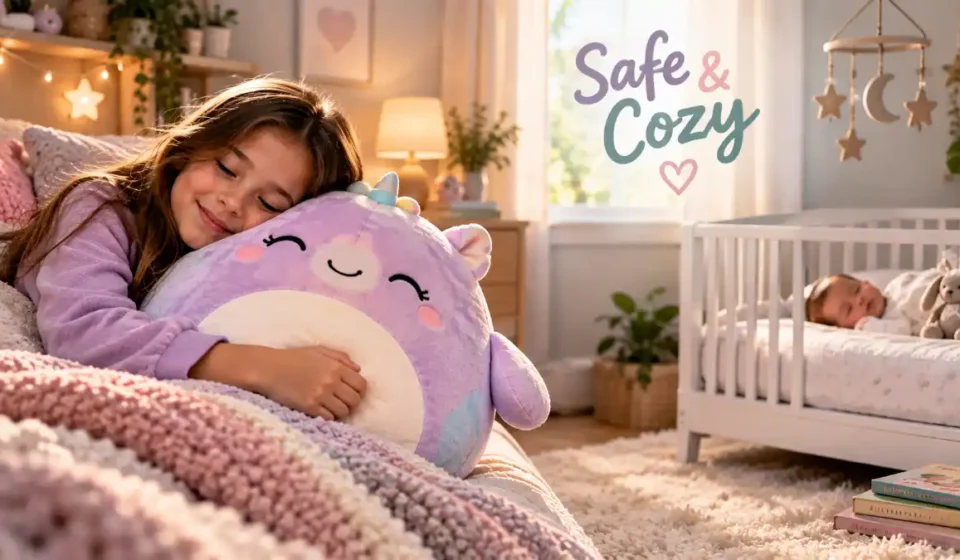

Parents searching for a Squishmallow pillow often want a simple answer: can a child sleep with one?
The answer depends on the child’s age, the specific product, and—most importantly—whether the product is being used inside an infant sleep environment.
A manufacturer’s age rating is not the same thing as pediatric safe-sleep guidance. That distinction is especially important for babies.
This guide explains what current product information says, what the American Academy of Pediatrics recommends for infant sleep, and how parents can make a safer decision for older children.
First: What Does “Squishmallow Pillow” Mean?
The phrase can describe two different products.
A traditional Squishmallows character is a plush toy. A SquishPillow is a purpose-built pillow sold by Jazwares.
The current Kids SquishPillow is listed by Jazwares for ages 3+, measures 13 × 18 inches, and includes a product warning about suffocation and infant sleep environments.
That product information is useful, but parents should not interpret “ages 3+” as a universal medical statement that every three-year-old can safely sleep with any pillow.
Is a Squishmallow Pillow Safe for Babies?
No Pillow in an Infant Sleep Space
For infants, the safest approach is clear.
The AAP recommends that babies sleep on their backs in their own sleep space, using a firm, flat sleep surface with a fitted sheet and no pillows, stuffed toys, or other soft objects.
That includes plush items that look like pillows.
The concern is not whether a particular character is cute, soft, or marketed for children. Soft objects can obstruct an infant’s nose or mouth and contribute to suffocation and other sleep-related hazards.
Read More: Squishmallow Pillow
What About a Product Labeled 3+?
An age label tells you about the manufacturer’s intended age range for that product.
It does not override safe-sleep recommendations for infants.
This is why parents should treat these as two separate questions:
- Is the product age-appropriate according to the manufacturer?
- Is the product appropriate to place in a child’s sleep environment?
For babies, the second question is governed by safe-sleep guidance, not simply the toy’s age label.
What Does the AAP Say About Soft Objects?
The AAP specifically recommends keeping soft objects such as pillows and pillow-like toys away from an infant’s sleep area.
Its guidance is based on reducing risks including:
- suffocation
- airway obstruction
- entrapment or wedging
- strangulation
- sleep-related infant death
The AAP also notes that there is not a precise age at which these objects can be declared 100% safe for every child. Most experts consider the risk lower for healthy babies after 12 months, but that should not be turned into a universal “12-month safety rule.”
What Does Jazwares Say About Its Kids SquishPillow?
The current Kids SquishPillow listing provides several important product-specific details.
Jazwares lists it as:
- Ages 3+
- 13 × 18 inches
- A Kids SquishPillow with pillowcase
- A product carrying an explicit suffocation warning
The manufacturer’s warning is particularly relevant when parents are deciding whether a pillow belongs near a baby.
This is why product labeling should always be read together with pediatric guidance.
Is It Safe for a 3-Year-Old?
The safest way to answer this is not with a blanket yes or no.
A product being labeled 3+ means the manufacturer considers it appropriate for that age range under its intended product-use conditions.
But whether a particular child should sleep with a pillow depends on the child’s developmental stage, sleep environment, and individual circumstances.
Parents should also distinguish between:
- supervised cuddling
- lounging
- resting with a plush
- overnight sleep
- using the product in a crib
Those are not identical situations.
Supervised Cuddling
A child using a Squishmallows plush while awake and supervised is a different situation from leaving soft objects in an infant sleep space.
Bedtime for Older Children
For children who are beyond infancy, parents can consider the child’s age, development, sleep habits, product instructions, and any guidance from their pediatrician.
If there is a specific medical or developmental concern, an individualized pediatric assessment is more appropriate than relying on a generic online age rule.
Read More: Squishmallow Pillow
Squishmallow Pillow vs. Stuffed Animal
This distinction is easy to overlook.
A traditional Squishmallows plush is generally purchased as a character plush.
The official SquishPillow is designed as a pillow.
That means the manufacturer’s instructions and intended use can differ.
Parents should check the exact product instead of assuming that the safety information for one Squishmallows item automatically applies to another.
What Should Parents Check Before Buying?
1. Check the Age Rating
Look at the exact product listing or packaging.
Do not rely only on the word “Squishmallows.”
2. Read the Warnings
Warnings are part of the product’s safety information.
For the current Kids SquishPillow, Jazwares provides a specific suffocation warning related to infants and sleep environments.
3. Check the Condition
Avoid products that are:
- torn
- leaking
- unusually sticky
- damaged
- shedding filling
- missing important labels or safety information
4. Buy From a Trustworthy Seller
This matters particularly for marketplace purchases.
The CPSC’s August 2026 warning about counterfeit squishy toys says fake products may lack required age grading, warnings, tracking information, manufacturer identification, testing, or certification.
Importantly, this CPSC warning is about counterfeit squishy toys generally. It should not be presented as evidence of a Squishmallows-specific defect or recall.
How to Spot a Potentially Problematic Squishy Toy
The CPSC advises consumers to avoid fake or counterfeit squishy toys and to stop using a squishy toy if it has an unknown manufacturer, lacks required safety information, has a strong chemical odor, feels oily or unusually sticky, leaks, or can be easily torn apart.
These checks are especially useful when buying through unfamiliar sellers.
Why Counterfeits Deserve Attention
A counterfeit product may look almost identical to the genuine product.
But appearance does not establish that it was manufactured or tested to the same standards.
For parents, that makes seller verification and packaging information worth checking.
Read More: Squishmallow Pillow
What About Sleeping With a Squishmallow Plush?
This is where parents should avoid one-size-fits-all advice.
For an infant, the AAP’s recommendation is straightforward: keep pillows, stuffed toys, and other soft objects out of the sleep space.
For older children, the question becomes more individualized.
The product’s age rating, the child’s age and development, the condition of the product, and the child’s sleeping environment all matter.
A plush used for daytime cuddling should not automatically be treated as a sleep product.
Safer Ways to Use a Squishmallow With Younger Children
If your child enjoys Squishmallows, you do not necessarily need to remove them from the child’s life.
Instead, separate awake use from infant sleep use.
During the Day
A child can use an age-appropriate plush for:
- cuddling
- imaginative play
- reading
- lounging
- supervised comfort
During Infant Sleep
Keep the sleep area free of pillows, plush toys, loose blankets, and other soft items in accordance with AAP safe-sleep recommendations.
That simple separation eliminates much of the confusion surrounding the phrase “safe pillow.”
Read More: Squishmallow Pillow
Common Mistakes Parents Make
Mistake 1: Treating “3+” as a Sleep-Safety Certification
It is not.
Age grading and safe-sleep recommendations answer different questions.
Mistake 2: Assuming a Soft Product Is Automatically Safer
Softness is not a safe-sleep qualification.
For infants, the issue is that soft objects can obstruct the airway.
Mistake 3: Assuming Every Squishmallows Product Is Identical
Different products can have different designs, dimensions, intended uses, and warnings.
Mistake 4: Ignoring Product Damage
A damaged plush or pillow can create additional hazards.
Inspect products periodically.
Mistake 5: Assuming Online Marketplace Listings Are Always Authentic
Counterfeit products exist across the broader squishy-toy market, so seller and product verification matter.
A Simple Parent Decision Guide
If your child is an infant, do not place a Squishmallow pillow, stuffed toy, or other soft object in the infant’s sleep space. Follow AAP safe-sleep guidance.
If your child is older than infancy, evaluate the exact product, age rating, warnings, condition, intended use, and your child’s individual circumstances.
If your child has a specific medical or developmental concern, ask the child’s pediatrician rather than relying on a generic age cutoff.
Bottom Line
A squishmallow pillow is not automatically safe or unsafe simply because it carries the Squishmallows name.
For infants, the recommendation is much clearer: keep pillows, pillow-like toys, stuffed toys, and other soft objects out of the sleep environment.
For older children, product labeling and individual circumstances become more relevant.
The most important lesson for parents is simple:
Do not confuse a manufacturer’s age rating with pediatric safe-sleep guidance.
That distinction makes the decision much clearer.
Frequently Asked Questions
Can a baby sleep with a Squishmallow pillow?
No. The AAP recommends keeping pillows, stuffed toys, and other soft objects out of an infant’s sleep space.
Is the Kids SquishPillow safe for infants?
The current Jazwares listing is labeled ages 3+ and includes a warning against using pillows in infant sleep environments.
Does age 3+ mean a child can safely sleep with it?
No. An age rating is not the same as a universal pediatric sleep-safety recommendation.
What does the AAP say about pillows for babies?
The AAP recommends keeping pillows and other soft objects out of an infant’s sleep area.
Can older children sleep with Squishmallows?
The answer depends on the child, product, age, and circumstances. The infant safe-sleep recommendation should not be extended into a universal rule for every older child.
Is a Squishmallows plush the same as a SquishPillow?
No. A traditional Squishmallows plush is a character-based plush, while SquishPillow is a dedicated pillow product.
What age is the Kids SquishPillow for?
The current Jazwares listing says ages 3 and up.
What should I do if the plush is torn or leaking?
Stop using a damaged product. The CPSC specifically advises stopping use of squishy toys that leak or can be easily torn apart.
Are counterfeit Squishmallows dangerous?
The CPSC has warned about counterfeit squishy toys generally. That warning should not be interpreted as a Squishmallows-specific recall, but it does support checking sellers and product information carefully.
Who should I ask about my child’s individual sleep situation?
For a child-specific medical or developmental question, speak with your pediatrician.