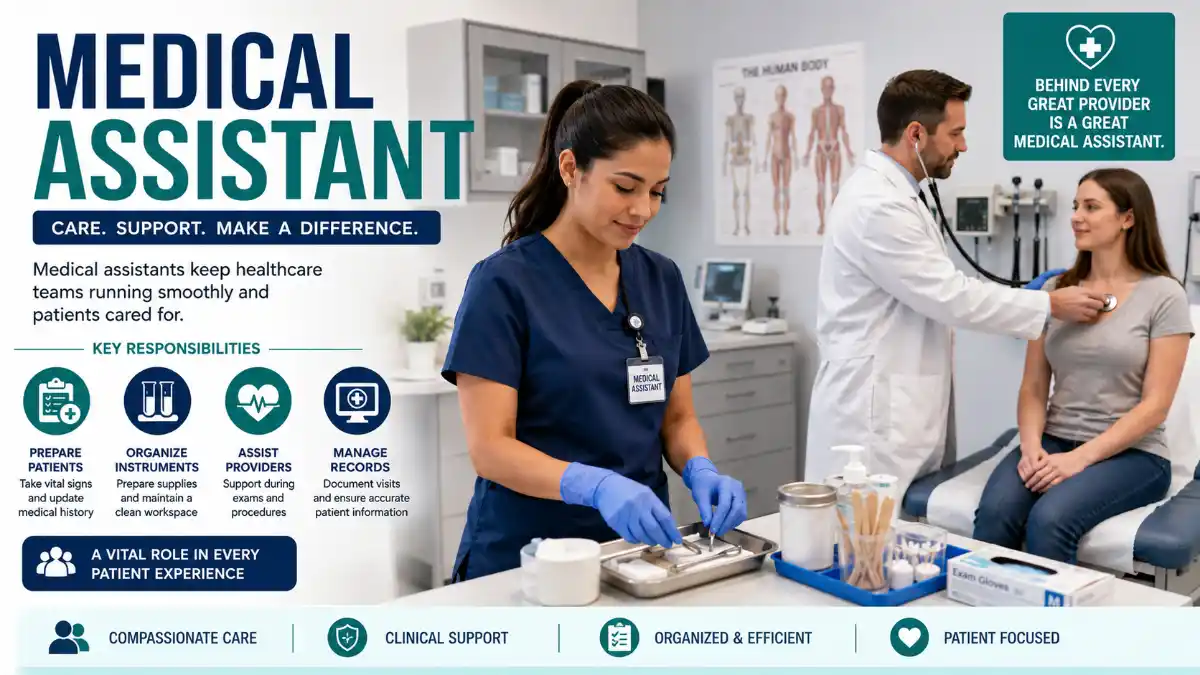

A medical assistant helps keep an outpatient healthcare visit organized from the moment a patient arrives until follow-up tasks are completed. Depending on the employer, a medical assistant may schedule appointments, update records, take vital signs, prepare patients for examinations, collect specimens, assist with procedures, and support other members of the healthcare team.
It is a practical healthcare career that combines patient interaction with administrative work. The exact duties vary by state, specialty, employer, training, and supervision. If you are considering this career, the most important questions are usually simple: What does a medical assistant do, how much can you earn, how do you become one, and is the job a good fit?
What Does a Medical Assistant Do?
A medical assistant performs a combination of clinical and administrative duties in healthcare settings. The U.S. Bureau of Labor Statistics (BLS) describes the occupation as involving tasks such as interviewing patients, recording medical histories, measuring vital signs, assisting with examinations, scheduling appointments, collecting specimens, and maintaining medical records.
The balance between clinical and administrative work depends heavily on the workplace. One practice may expect an MA to spend most of the day rooming patients and assisting with procedures, while another may place greater emphasis on scheduling, referrals, records, and front-office operations.
The role is therefore broader than simply “helping the doctor.” A good medical assistant helps maintain accurate information, efficient patient flow, organized clinical areas, and clear communication throughout the visit.
Medical Assistant Duties Before the Appointment
Before the clinician sees a patient, a medical assistant may:
- Confirm patient identity and demographic information
- Review or update medical history
- Confirm medications and allergies
- Record the reason for the visit
- Measure height, weight, blood pressure, pulse, temperature, or other vital signs
- Prepare examination rooms
- Update the electronic health record (EHR)
- Prepare equipment and supplies
- Identify information that needs to be brought to the clinician’s attention
Accuracy matters at this stage. A medication, allergy, demographic detail, or vital-sign reading should not be guessed or entered carelessly. Medical assistants follow established procedures and escalate concerns to the appropriate licensed professional.
Medical Assistant Duties During the Visit
During an examination, a medical assistant may help prepare the patient, provide equipment, document information, maintain supplies, or assist the clinician with routine procedures.
Depending on the setting and applicable rules, duties may include:
- Assisting with physical examinations
- Preparing patients for procedures
- Performing or assisting with EKGs
- Collecting blood or other specimens
- Changing dressings or providing basic wound-care support
- Administering certain medications or vaccines when permitted and appropriately directed
- Providing standardized patient instructions
- Recording information in the EHR
Cleveland Clinic lists examples including vital signs, specimen collection, blood draws, EKGs, wound care, and medication or vaccine administration as possible clinical duties.
However, these should never be interpreted as universal duties. State law, employer policy, training, competency, and supervision can determine whether a particular task is permitted.
Medical Assistant Duties After the Visit
After an appointment, a medical assistant may help with:
- Scheduling follow-up appointments
- Coordinating referrals
- Preparing laboratory paperwork
- Updating patient records
- Relaying provider-authorized information
- Preparing forms
- Restocking rooms and supplies
- Supporting the next patient’s visit
This part of the job is easy to overlook, but it is essential to keeping a busy practice moving.
Clinical vs. Administrative Medical Assistant Roles
Not every medical assistant has the same daily workload. Some positions are primarily clinical, some are primarily administrative, and many combine both.
| Role | Main focus | Typical responsibilities |
| Clinical medical assistant | Patient-care support | Rooming patients, vital signs, histories, specimen collection, EKGs, procedure assistance |
| Administrative medical assistant | Office operations | Scheduling, check-in, calls, records, referrals, insurance-related tasks and paperwork |
| General medical assistant | Combination of both | Clinical and administrative duties throughout the patient visit |
Read More: Medical Assistant
A clinical medical assistant generally spends more time working directly with patients and supporting clinical workflows. An administrative MA may spend more time at a front desk or computer.
Job titles are not always standardized, though. Always read the actual job description instead of assuming the title tells you everything about the position.
Where Do Medical Assistants Work?
Medical assistants commonly work in outpatient healthcare environments. BLS reports that the largest employment setting is physicians’ offices, followed by hospitals, outpatient care centers, and offices of other healthcare practitioners.
Common workplaces include:
- Primary-care offices
- Family medicine practices
- Pediatric clinics
- OB-GYN practices
- Dermatology clinics
- Cardiology practices
- Orthopedic clinics
- Urgent-care centers
- Community health centers
- Hospital-owned outpatient clinics
- Specialty medical offices
- Ambulatory care settings
The specialty can significantly change the day-to-day experience.
A pediatric practice may involve growth measurements, family communication, immunization-related workflows, and preventive visits. A dermatology office may involve procedure preparation and specialized documentation. An orthopedic practice may involve mobility-related support, imaging coordination, and examination preparation.
Before accepting a position, ask how much of the role is clinical, how much is administrative, what procedures are performed, and what training is provided.
What Is a Medical Assistant Not?
A medical assistant is not a physician, registered nurse, nurse practitioner, or physician assistant.
The occupation has a different education pathway, scope of practice, and professional role. Medical assistants support healthcare professionals but do not automatically acquire the authority associated with licensed clinical professions.
A medical assistant should not independently diagnose a patient, prescribe medication, make independent medical decisions, or interpret medical results as a substitute for the appropriate clinician.
The specific boundaries of clinical work also vary by state and employer. AAMA notes that medical-assisting scope-of-practice rules differ across states, and medical assistants are generally treated as unlicensed personnel.
A useful rule is to consider four questions before performing a clinical task:
- Is the task allowed under applicable state law?
- Does the employer permit the task?
- Has the appropriate professional delegated or directed it?
- Has the medical assistant received appropriate training and demonstrated competency?
If the answer is unclear, the task should be clarified with the appropriate supervisor or licensed professional rather than guessed.
How to Become a Medical Assistant
The typical route into medical assisting starts with education and practical training. BLS says medical assistants typically need postsecondary education such as a certificate, although some people enter the occupation with a high school diploma and learn through on-the-job training.
Choose a Medical Assisting Program
Programs may lead to a certificate or diploma, while others offer an associate degree.
When comparing programs, look beyond the advertised tuition. Consider:
- Program accreditation
- Length of the program
- Clinical or practicum experience
- Total tuition and fees
- Books and equipment
- Certification eligibility
- Class schedule
- Transportation requirements
- Graduate outcomes
- Employer recognition in your area
A short program is not automatically the best program. The better choice is the one that fits your career goal and provides appropriate preparation.
Check Certification Eligibility Before Enrolling
If you plan to pursue the CMA (AAMA)® credential, verify the program’s eligibility before paying tuition.
AAMA states that one major eligibility route requires being a student or graduate of a medical assisting program accredited by CAAHEP or ABHES. AAMA also provides other eligibility pathways, so candidates should review the current requirements rather than relying on old school brochures or third-party summaries.
This distinction is important because not every healthcare certificate qualifies a graduate for every certification examination.
Build Practical Skills
Employers may value candidates who can demonstrate competence in areas such as:
- Vital-sign measurement
- Patient communication
- EHR use
- Confidentiality and privacy
- Infection-control practices
- Examination-room preparation
- Specimen-handling basics
- Appointment scheduling
- Referral coordination
- Professional documentation
- Escalating patient concerns appropriately
- Working efficiently during busy clinic periods
Training gives you the foundation, but the ability to communicate accurately and work reliably is equally important.
Medical Assistant Certification Options
Certification is not the same thing as licensure, and earning a credential does not override state law or employer requirements.
Two credentials frequently encountered by medical-assisting candidates are CMA (AAMA)® and CCMA.
CMA (AAMA)®
The Certified Medical Assistant credential is awarded through the American Association of Medical Assistants.
AAMA’s current eligibility requirements include several pathways. One principal route is graduation from a medical assisting program accredited by CAAHEP or ABHES.
The CMA (AAMA) credential also has a continuing-certification requirement. AAMA states that CMAs (AAMA) must recertify every 60 months, using continuing education or examination according to the applicable requirements.
CCMA
The Certified Clinical Medical Assistant (CCMA) credential is offered by the National Healthcareer Association (NHA).
NHA’s current eligibility information includes education and training routes as well as specified supervised work-experience routes. Candidates should check the current requirements before applying because eligibility policies can change.
Which Certification Should You Choose?
There is no universal answer.
Compare:
- Eligibility requirements
- Cost
- Examination content
- Renewal requirements
- Employer preferences
- Program alignment
- Recognition in the geographic area where you want to work
Most importantly, do not choose a credential simply because its acronym appears frequently in job advertisements. Check what the employers you actually want to work for request or prefer.
What Does a Medical Assistant Salary Look Like?
A medical assistant salary depends on location, experience, employer, specialty, work setting, and schedule.
According to BLS, the median annual wage for medical assistants was $44,200 in May 2024, equivalent to $21.25 per hour. BLS also reported that the lowest 10% earned less than $35,020 while the highest 10% earned more than $57,830.
These figures are national statistics, not guaranteed starting salaries.
BLS also reported different median wages by major employment setting in May 2024:
| Employment setting | 2024 median annual wage |
| Outpatient care centers | $47,560 |
| Hospitals | $45,930 |
| Offices of physicians | $43,880 |
| Offices of other health practitioners | $37,510 |
Read More: Medical Assistant
Location can make a substantial difference as well. A salary that is competitive in one region may be relatively low in another.
When comparing offers, look beyond the headline wage.
| Compensation factor | Why it matters |
| Hourly pay | Determines base earnings and affects overtime calculations |
| Health insurance | Premiums, deductibles, and coverage can change total compensation |
| Paid time off | Adds value beyond the hourly rate |
| Schedule | Evening, weekend, or holiday work may affect lifestyle and pay |
| Commute | Fuel, parking, tolls, and travel time have real costs |
| Certification support | Exam fees, continuing education, or reimbursement can reduce expenses |
| Advancement | Training and promotion opportunities may increase long-term earning potential |
Is Medical Assisting a Good Career?
Medical assisting can be a good career for someone who wants an entry-level healthcare role involving both people and practical tasks.
It may be a strong fit if you enjoy:
- Working directly with patients
- Organizing multiple tasks
- Communicating clearly
- Following established procedures
- Working as part of a healthcare team
- Learning clinical terminology and workflows
- Balancing computer-based and hands-on work
It may be less appealing if you strongly prefer independent work, dislike frequent patient interaction, or want a role with substantially greater clinical authority.
The work can also be physically and mentally demanding. Medical assistants may spend significant time standing, walking, moving between rooms, handling interruptions, and managing several priorities at once.
Medical Assistant Job Outlook
The employment outlook is one reason medical assisting attracts career changers and healthcare students.
BLS projects 12% employment growth from 2024 to 2034, which is much faster than the average for all occupations. It also projects about 112,300 openings per year, on average, over the decade.
The projected openings are not all new positions. BLS notes that many openings are expected to result from workers leaving the occupation or moving into other occupations.
That makes the career outlook useful, but it should not be interpreted as a guarantee that every graduate will immediately find a high-paying position.
Career Growth After Medical Assisting
Medical assisting does not have to be the final step in a healthcare career.
With experience, an MA may move into roles involving:
- Lead medical assisting
- Specialty-clinic work
- Staff training
- Referral coordination
- Patient navigation
- Practice operations
- Medical office management
- Billing or coding
- Quality-improvement activities
- Care coordination
Some people also use medical-assisting experience as exposure to healthcare before pursuing additional education for another profession.
However, experience as a medical assistant does not replace the education and licensing requirements for careers such as registered nursing, radiography, sonography, respiratory therapy, or physician assistant practice.
What Skills Make a Good Medical Assistant?
Technical knowledge is only part of the job.
A successful medical assistant also needs dependable professional habits.
Accuracy
Patient information, documentation, measurements, and scheduling details must be handled carefully.
Communication
MAs interact with patients, clinicians, coworkers, laboratories, insurers, and other organizations. Clear communication prevents avoidable confusion.
Organization
A busy clinic can involve multiple patients, phone calls, records, rooms, procedures, and follow-up tasks at the same time.
Empathy
Patients may be anxious, uncomfortable, confused, or frustrated. A calm and respectful interaction can make the experience easier.
Professional Boundaries
Knowing when to answer a question, when to follow a protocol, and when to involve a licensed professional is a fundamental part of safe practice.
Frequently Asked Questions
Is a medical assistant a nurse?
No. A medical assistant and a nurse have different education, professional roles, legal authority, and licensing requirements. An MA may work alongside nurses and other clinicians but does not replace a licensed nurse.
What are the main medical assistant duties?
Common duties include patient intake, vital signs, medical-history documentation, examination support, specimen collection, EKG-related tasks, scheduling, record maintenance, referrals, and other administrative or clinical support activities. The exact duties depend on the employer and applicable rules.
What is a clinical medical assistant?
A clinical medical assistant focuses primarily on patient-care support. Duties may include rooming patients, taking vital signs, collecting specimens, preparing patients for examinations, assisting with procedures, and maintaining clinical supplies.
Can medical assistants draw blood?
A medical assistant may be permitted to collect blood specimens when the task is allowed by applicable law, employer policy, training, competency requirements, and supervision. The rules are not identical everywhere.
How long does it take to become a medical assistant?
There is no single timeline because programs vary. Certificate and diploma programs can provide a relatively direct route into the occupation, while associate-degree programs generally require more coursework. BLS notes that some people also enter the occupation with a high school diploma and receive on-the-job training.
Is medical assistant certification required?
Certification requirements vary by employer and location. Certification is not synonymous with state licensure, and candidates should check the requirements of the jobs they want. If pursuing CMA (AAMA)®, candidates must meet AAMA’s eligibility requirements.
What is the difference between CMA (AAMA) and CCMA?
They are different credentials administered by different organizations. CMA (AAMA) is awarded through the American Association of Medical Assistants, while CCMA is a Certified Clinical Medical Assistant credential offered by the National Healthcareer Association. Their eligibility and renewal requirements differ.
How much does a medical assistant make?
The BLS reported a median annual wage of $44,200 for medical assistants in May 2024, or $21.25 per hour. Actual pay varies by location, employer, specialty, experience, and work setting.
Can a medical assistant work in a specialty clinic?
Yes. Medical assistants work in primary care and many specialties, including pediatrics, dermatology, cardiology, orthopedics, women’s health, and other outpatient settings. The duties can change significantly from one specialty to another.
Is medical assisting a good career for beginners?
It can be a practical entry point into healthcare because the occupation combines patient interaction, administrative work, and clinical support. However, prospective students should compare program quality, certification eligibility, local job requirements, expected pay, schedule, and advancement opportunities before enrolling.