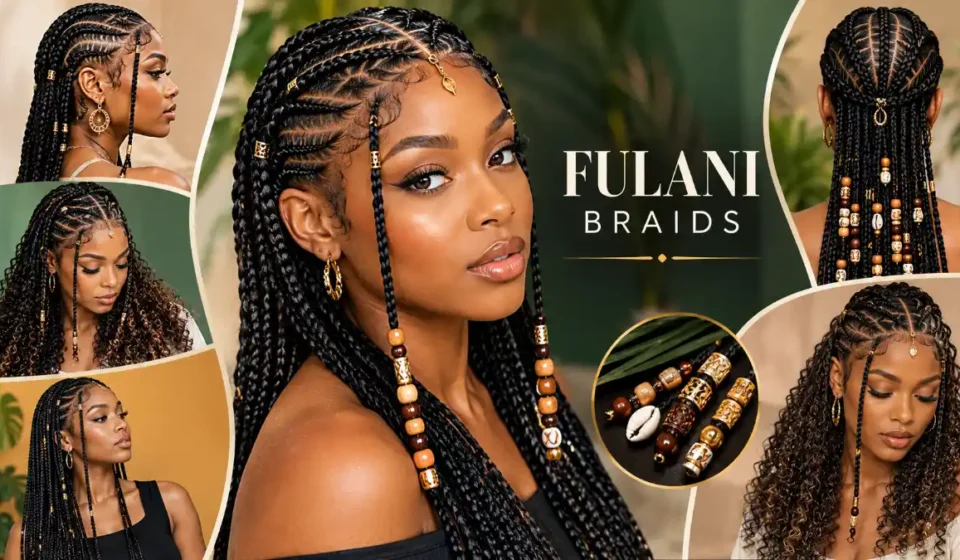

Fulani braids are known for their distinctive combination of cornrow patterns, central parting or raised sections, side-directed braids, loose lengths, and decorative details such as beads or cuffs. Today, the style has expanded into many variations, including knotless installs, boho finishes, curly ends, different braid sizes, and colorful extensions.
What makes the style especially versatile is that the underlying pattern can stay recognizable while the size, accessories, texture, length, and finish change dramatically. Whether you’re looking for Fulani braid styles for an everyday look or a statement hairstyle for an event, understanding the main variations makes it much easier to choose the right design.
What Are Fulani Braids?
Fulani braids are a family of braided hairstyles associated with the Fula, Fulani, or Fulɓe people of the Sahel and West Africa. The Smithsonian’s National Museum of African American History and Culture identifies the hairstyle as coming from the Fula, Fulani, or Fulɓe people and notes its influence across the African diaspora.
There is no single modern template that every stylist follows. Instead, the term generally describes recognizable design elements that can be interpreted in different ways.
Common features include:
- Cornrows or braids directed toward different parts of the scalp
- A defined center or front-to-back design
- Face-framing braids
- Braids hanging freely from the sides or back
- Beads, shells, cuffs, or other decorative accessories
- Combinations of cornrows and individual braids
- Modern additions such as curls, color, and different extension textures
The historical context is important because braided hairstyles can carry cultural meaning beyond their appearance. Smithsonian material notes that hairstyles in African and Black communities have served functional and social purposes and, in some cultures, communicated information about background, status, identity, and life events.
That means it is more accurate to think of contemporary versions as modern interpretations of a hairstyle tradition rather than assuming every variation has the same historical meaning.
Fulani Braids: Traditional Influence and Modern Styling
The cultural history behind the hairstyle is richer than a simple beauty trend. Historical and museum records document distinctive Fulbe hairstyles and their relationship to identity and life stages. A Smithsonian record concerning Fulani WoDaaBe women, for example, describes distinctive hairstyles associated with successive stages of life.
The Metropolitan Museum of Art also documents a braided coiffure associated with Fulbe women in the Futa Jallon region, showing how recognizable Fulbe hair traditions have been represented in African art.
Modern salon versions, however, can look quite different from historical examples. A contemporary stylist may combine the recognizable braided layout with knotless techniques, synthetic extensions, curly hair, colored strands, or minimalist accessories.
This distinction helps explain why searches for Fulani braids hairstyles produce such a wide range of results. Some are closer to traditional-inspired designs, while others are highly modern interpretations.
Popular Fulani Braids Styles
The best way to compare the options is to look at what changes from one design to another. The braid pattern is only one part of the finished hairstyle; size, texture, accessories, length, and installation technique can completely change the appearance.
Fulani Braids With Beads
Fulani braids with beads are among the most recognizable versions of the style. Beads can be added to individual braids, concentrated around face-framing sections, or distributed throughout the hairstyle.
Common accessories include:
- Wooden beads
- Cowrie shells
- Metallic cuffs
- Colored beads
- Small decorative charms
- Neutral or earth-toned accessories
The number of accessories does not determine whether a hairstyle is attractive. Strategic placement can create a cleaner result than covering every braid with decoration.
If you’re choosing beads for a particular occasion, consider their size and weight. Multiple heavy accessories can make an already-tensioned hairstyle feel less comfortable, especially around the hairline.
Jumbo Fulani Braids
Jumbo designs use fewer, thicker sections. They create a bold graphic effect and can make the underlying scalp pattern easier to see.
They can be a practical option when you want a visually dramatic hairstyle without the extremely fine sections associated with microbraiding. The downside is that fewer, larger sections do not automatically mean a hairstyle will last longer or be healthier for the hair. Installation quality, tension, maintenance, hair growth, and the weight of extensions all matter.
Read More: Fulani Braids
Small and Micro Fulani Braids
Small designs create more room for intricate patterns, detailed parting, and delicate accessories.
They can provide a highly detailed finish, but they also require more sectioning and braiding work. A longer appointment is therefore common, although exact installation time depends on the stylist, hair length, density, technique, and desired design.
If your priority is intricate styling, small sections can be appealing. If your priority is a shorter appointment or a simpler maintenance routine, medium or larger sections may be more practical.
Medium Fulani Braids
Medium sections offer a middle ground between highly detailed micro designs and bold jumbo braids.
They provide enough space for decorative details while keeping the overall pattern easy to see. For someone booking the style for the first time, medium sections can be a useful starting point because they allow flexibility without committing to an extremely intricate installation.
Boho Fulani Braids With Curls
Boho Fulani braids combine the structured appearance of braids with loose curls or waves.
Curly pieces may be incorporated at the ends, left loose between braids, or added to selected face-framing sections. The contrast between controlled braiding and loose texture creates a softer, more relaxed appearance.
This is one of the most noticeable modern adaptations because the curly finish changes the overall mood of the hairstyle without completely abandoning the recognizable braided foundation.
For Fulani braids with curls, ask the stylist exactly where the loose hair will be placed. Two styles can both be described as boho while having very different amounts of exposed curl.
Knotless Fulani Braids
Knotless styling refers primarily to the installation technique rather than a completely different braid pattern.
Instead of creating a visible knot at the root when adding extension hair, the stylist gradually incorporates the extension into the braid. This can produce a flatter-looking beginning and a less bulky root.
However, “knotless” should not automatically be treated as synonymous with tension-free. The amount of tension still depends on how tightly the natural hair is sectioned and braided, how much extension hair is added, and how the stylist works around the hairline.
For anyone concerned about scalp comfort, communication with the stylist is more important than the label alone.
Colored Fulani Braids
Color is another easy way to change the personality of the hairstyle without changing its basic pattern.
You can use:
- One accent color
- Ombre extensions
- Two complementary shades
- Bright fashion colors
- Burgundy, brown, or copper tones
- Subtle highlights mixed with natural-looking hair
Colored extension hair can change the appearance without requiring you to chemically color your natural hair.
Fulani Braids for Women: How to Choose the Right Design
There is no single version that works best for everyone. The right choice depends on your desired appearance, natural hair, lifestyle, appointment time, and tolerance for accessories or length.
| Style | Main Feature | Good Choice If You Want |
| Beaded | Beads or shells | A decorative, recognizable finish |
| Jumbo | Thick sections | A bold, graphic appearance |
| Medium | Balanced sections | Versatility and moderate detail |
| Small | Fine braids | Intricate patterns |
| Knotless | Gradual extension feed-in | A flatter-looking root |
| Boho | Loose curls or waves | A softer, textured finish |
| Colored | Colored extensions | A fashion-forward appearance |
Read More: Fulani Braids
Your reference photo should show more than the overall hairstyle. If possible, identify the braid size, length, parting pattern, accessory placement, and whether the ends are straight, curled, or left loose.
That information gives the stylist a much clearer idea of what you actually want.
How to Choose Beads and Accessories
Accessories can turn a relatively simple braid pattern into a statement hairstyle, but more decoration is not always better.
For a subtle finish, use a few beads on selected face-framing braids. For a more traditional-inspired appearance, you may prefer natural-looking wooden beads or shell details. Metallic cuffs can create a more contemporary finish.
Consider these factors before your appointment:
- Weight: Large numbers of heavy accessories can add unnecessary load.
- Placement: Hairline sections deserve particular care because they can already experience tension.
- Color: Neutral accessories blend easily with natural hair colors, while bright beads create stronger contrast.
- Removal: Choose accessories that can be removed without pulling or cutting the braid.
- Overall balance: Match accessory size to braid size.
The goal is to make the accessories work with the pattern rather than overwhelm it.
Choosing Extension Hair for Fulani Braids Hairstyles
The extension hair you choose affects the final texture, weight, length, and appearance.
Synthetic braiding hair is widely used because it is available in many colors and lengths and is designed for braided installations. Pre-stretched options can also reduce some of the preparation work involved in getting extension hair ready for braiding.
For boho Fulani braids with curls, the choice becomes more specific. You may use pre-curled synthetic hair, wavy extensions, or another extension type selected by the stylist for the desired finish.
Rather than choosing hair solely because a product is popular, match the extension to the hairstyle you want. A sleek, structured style and a loose boho style have different texture requirements.
Also consider the total weight of the finished installation. Longer and heavier extensions can increase the load on the natural hair, particularly when the hairstyle is worn continuously.
Read More: Fulani Braids
How Long Do Fulani Braids Last?
There is no universal wear time that applies to every installation.
Longevity depends on factors such as:
- Braid size
- Hair growth rate
- Natural hair texture
- Extension length and weight
- Installation technique
- Scalp and hair care
- Friction during sleep
- Humidity and daily activity
- How frequently the hairstyle is restyled
Smaller braids should not automatically be advertised as lasting a specific number of weeks. A well-installed hairstyle can still become unsuitable if the roots grow out significantly, the scalp becomes uncomfortable, or the natural hair starts showing signs of stress.
The American Academy of Dermatology recommends avoiding prolonged tension and says dermatologists advise keeping braids and similar styles for no longer than about six to eight weeks. It also recommends loosening braids around the hairline and changing hairstyles regularly.
For that reason, “how long will it last?” should be treated separately from “how long should I keep it in?”
Are Fulani Braids Safe for Your Hair?
Braids can be a useful styling option, but the installation should not hurt.
Tight braids, cornrows, extensions, ponytails, and other hairstyles that repeatedly pull on the hair can contribute to traction alopecia, a form of hair loss caused by prolonged or repeated tension. The American Academy of Dermatology specifically advises loosening braids around the hairline and changing hairstyles regularly.
Pay attention to warning signs such as:
- Pain during or immediately after installation
- Persistent scalp soreness
- Stinging or irritation
- Excessive tightness
- Broken hairs around the hairline
- Noticeable thinning where the hair is being pulled
If a hairstyle hurts, tell the stylist rather than assuming the discomfort is normal. The AAD specifically notes that pain from tightly pulled hair can be a warning sign of damaging tension.
A protective style should not require you to ignore scalp pain.
How to Prepare Before Getting Fulani Braids
Good preparation can make the appointment more comfortable and help the stylist work with your natural hair more effectively.
Before your appointment:
- Discuss the design first. Show the stylist the exact pattern and finish you want.
- Confirm the braid size. “Medium” can mean different things to different stylists.
- Discuss length and weight. Longer extensions may add more load.
- Mention scalp sensitivity. Tell the stylist if you normally experience discomfort with tight braids.
- Clarify the installation method. Ask whether the style will be knotless or knotted.
- Choose accessories in advance. This helps the stylist plan the braid sections.
- Start with hair in good condition. AAD guidance for extension styles recommends caring for natural hair before installation and using conditioner to help maintain its condition.
Most importantly, do not let a reference photo override what your natural hair and scalp can comfortably handle.
Read More: Fulani Braids
How to Maintain Your Braids
Maintenance should focus on the scalp, natural hair, and the physical condition of the braids.
A simple routine can include:
- Keeping the scalp clean according to your normal hair-care needs
- Avoiding unnecessary pulling when styling
- Using gentle handling around the hairline
- Limiting repeated tight ponytails and buns
- Protecting the hairstyle during sleep
- Removing accessories carefully
- Monitoring the roots for excessive tension or breakage
Restyling can also create additional stress. A braid installation may feel comfortable when worn down but become much tighter when repeatedly pulled into a high ponytail or bun.
The AAD advises against continuously wearing styles that pull on the hair and recommends switching hairstyles so the hair and scalp have opportunities to recover.
How Much Do Fulani Braids Cost?
The price of an installation varies too much by location and stylist to give one reliable universal figure.
Factors that commonly influence the quote include:
- Braid size
- Hair length
- Overall hairstyle length
- Natural hair density
- Extension quantity
- Knotless versus other installation methods
- Curly or boho finishing
- Beads and other accessories
- Stylist experience
- Salon or independent-stylist pricing
- Local market
A simple medium-length design with minimal accessories will generally require different labor and materials from a long, small-section style with curls and extensive beadwork.
Instead of relying on an old online price range, ask the stylist for a current quote and confirm exactly what is included.
Fulani Braids vs. Tribal Braids
The terms are sometimes used interchangeably online, but they are not necessarily identical.
Fulani braids refer to a hairstyle tradition associated with the Fula/Fulani/Fulɓe people, while “tribal braids” is often used in contemporary beauty marketing as a broad description for hairstyles incorporating patterns inspired by different African braiding traditions.
That distinction matters because a generic label can hide important differences in cultural origin and design.
If you want a specific Fulani-inspired pattern, describe the actual layout rather than relying only on the phrase “tribal braids.” Reference photos are especially useful because terminology can vary between stylists and salons.
Frequently Asked Questions
What makes Fulani braids different from regular braids?
The defining difference is the combination of a recognizable cornrow and individual-braid layout with decorative or face-framing elements associated with Fulani/Fula hairstyling traditions. Modern versions can vary significantly in size, texture, and accessories.
Are Fulani braids only worn with beads?
No. Beads are one of the best-known features, but modern designs can be worn without them. You can choose cuffs, shells, minimal accessories, curls, color, or no decoration at all.
Which Fulani braid size should I choose?
Medium sections are a practical starting point if you want a balance between detailed styling and a manageable installation. Choose smaller sections for more intricate designs and larger sections for a bolder appearance.
Can I get knotless Fulani braids?
Yes. Knotless installation can be combined with a Fulani-inspired pattern. The technique changes how extension hair is incorporated at the root; it does not by itself define the overall braid pattern.
Are Fulani braids with curls good for special occasions?
They can be a strong option if you want a softer, more textured appearance. The loose curls create a different finish from sleek, fully braided styles and can be customized around the face and ends.
Can I add color without dyeing my natural hair?
Yes. Colored extension hair can be incorporated into the installation, allowing you to experiment with highlights, ombre effects, or brighter shades without chemically coloring your natural hair.
How many beads should I put on my braids?
There is no universal number. The right amount depends on your braid size, accessory weight, desired appearance, and placement. A small number of carefully positioned beads can create a polished result.
Can Fulani braids be put into a ponytail or bun?
Yes, provided the installation is comfortable and the style is not pulled excessively tight. Repeatedly creating tight ponytails or buns can increase tension, so vary how you wear the braids.
How do I know if my braids are too tight?
Pain, stinging, excessive scalp tension, or discomfort around the hairline are warning signs. Do not assume that painful braiding is normal. Ask the stylist to loosen problematic sections, particularly around the hairline.
What should I show my stylist when booking Fulani braids?
Bring reference photos that show the front, sides, and back whenever possible. Tell the stylist your preferred braid size, length, accessory placement, curl level, color, and whether you want a knotless installation. This is much clearer than giving only a hairstyle name.