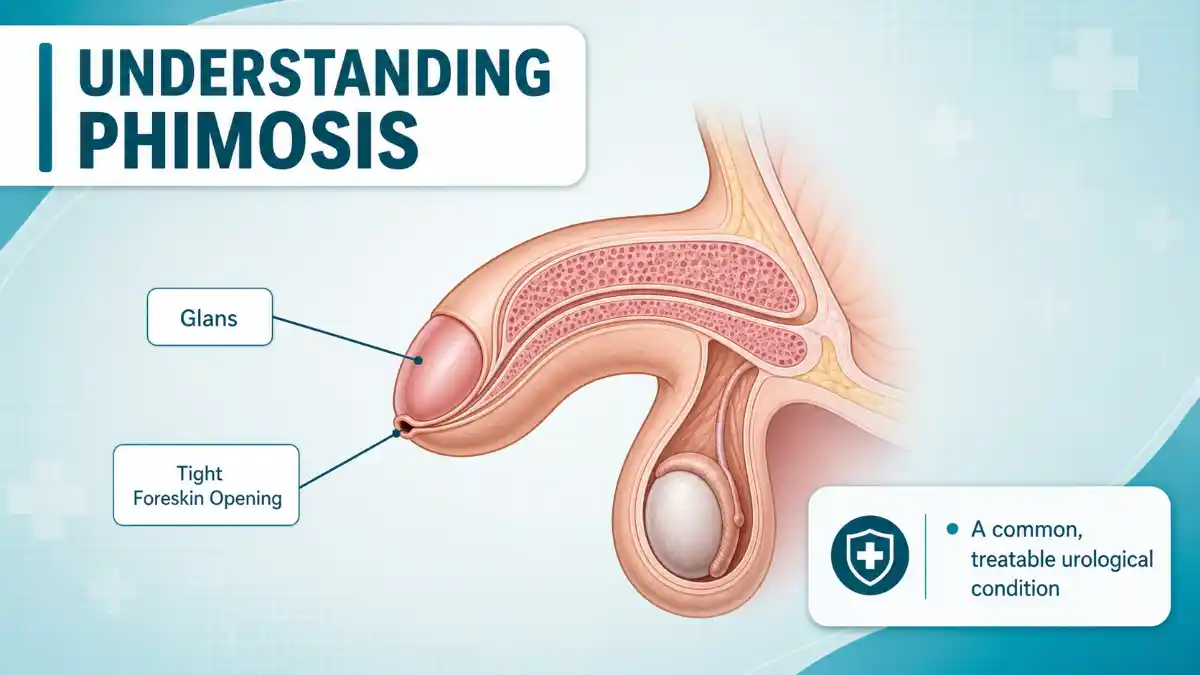

Phimosis in adults means the foreskin cannot be pulled back fully over the head of the penis (glans), or retraction has become unusually tight or painful. It is not always an emergency, but new or worsening tightness in adulthood deserves medical assessment, especially when it causes pain, cracking, repeated inflammation, or difficulty urinating.
Adult phimosis can develop because of inflammation, infection, skin disease, injury, or scarring. One important cause is lichen sclerosus, a chronic inflammatory skin condition that can gradually tighten and scar the foreskin.
The goal of treatment is not simply to make the foreskin retract. It is to identify the underlying cause, relieve symptoms, protect urinary and sexual function, and prevent further scarring or complications.
What Is Phimosis in Adults?
Phimosis is the inability to retract the foreskin comfortably over the glans. A foreskin that has always been somewhat tight may be different from one that becomes progressively tighter after years of normal retraction.
In adults, newly acquired or worsening tightness is more likely to need evaluation because inflammation or scarring may be involved. A clinician may describe this as pathological or acquired phimosis.
Phimosis does not automatically mean that treatment or circumcision is necessary. If the foreskin is comfortable, causes no recurrent inflammation,n and does not interfere with urination or sexual activity, treatment may not be immediately required. However, a changing or symptomatic foreskin should not be repeatedly forced.
What Are the Symptoms of Adult Phimosis?
The main symptom is difficulty retracting the foreskin. Other symptoms depend on the underlying cause and how severe the narrowing has become.
Common symptoms include:
- Inability to retract the foreskin fully
- A tight or constricting ring at the foreskin opening
- Pain or discomfort during retraction
- Painful erections
- Pain during sex or masturbation
- Small cracks or tears in the foreskin
- Bleeding after retraction or sexual activity
- Redness, itching or swelling
- Recurrent balanitis or balanoposthitis
- Discharge or unpleasant odour beneath the foreskin
- Pain or difficulty when urinating
- A weak urine stream
- Recurrent urinary infections
Some adults have a tight foreskin without significant symptoms. Others develop problems mainly when the penis becomes erect, because the narrowed opening has to stretch.
The NHS recommends medical assessment when a tight foreskin is painful or swollen, causes bleeding or discharge, produces painful erections, or makes urination difficult.
Why Does Phimosis Develop in Adults?
Adult phimosis is a physical finding rather than a single disease. The important question is why the foreskin has become tight.
Lichen Sclerosus
Lichen sclerosus is one of the most important causes of acquired foreskin scarring in adults. It can produce pale or white areas, fragile skin, thickening, cracking, and progressive tightening around the foreskin and glans.
On the penis, lichen sclerosus may make erections painful and can eventually interfere with foreskin retraction or the urinary opening. It is sometimes referred to in urology as balanitis xerotica obliterans (BXO).
Lichen sclerosus is not caused by poor hygiene and is not a sexually transmitted infection. It can, however, cause significant scarring and requires appropriate medical management.
Recurrent Balanitis
Balanitis is inflammation of the glans. When both the glans and foreskin are inflamed, the condition may be called balanoposthitis.
Inflammation can be associated with yeast, bacterial infection, irritation, sexually transmitted infections, and underlying skin conditions. Repeated inflammation may contribute to tightening and scarring.
If balanitis keeps returning, treating each episode without investigating the underlying cause may not solve the problem.
Diabetes and Recurrent Inflammation
Diabetes can increase susceptibility to certain infections and inflammatory problems affecting the foreskin. For this reason, a clinician may consider blood-glucose testing when adult phimosis occurs alongside recurrent balanitis or other features suggesting diabetes.
This does not mean that phimosis automatically indicates diabetes. It is simply one possible factor to consider during an appropriate medical assessment. BAUS notes that blood-glucose testing may be used when evaluating an adult with a tight foreskin.
Injury and Scarring
Repeated tearing can create scar tissue. Forceful attempts to retract a tight foreskin may cause small fissures, which can heal with additional tightening.
Friction during sexual activity can also aggravate an already inflamed or scarred foreskin. This is why repeatedly forcing the foreskin farther back is not a safe substitute for diagnosis.
Other Skin Conditions
Conditions such as eczema, psoriasis, lichen planus and contact dermatitis can affect genital skin and contribute to inflammation or tightness.
Some infections and sexually transmitted infections can also produce symptoms around the foreskin. The appropriate treatment therefore depends on the actual diagnosis rather than simply treating the tightness itself.
Phimosis vs. Frenulum Breve vs. Paraphimosis
Not every problem with foreskin movement is phimosis.
| Condition | What happens | Typical urgency |
| Phimosis | The foreskin cannot retract fully because the opening is too tight | Usually non-emergency, but symptomatic or acquired cases need assessment |
| Short frenulum (frenulum breve) | The band underneath the glans is too short and may pull the glans downward during retraction or erection | Usually routine assessment |
| Balanitis | The glans and/or foreskin becomes inflamed, red, swollen, or painful | Prompt assessment if severe or recurrent |
| Paraphimosis | A retracted foreskin becomes trapped behind the glans and cannot be pulled forward | Medical emergency |
Read More: Phimosis
A short frenulum can sometimes be mistaken for foreskin tightness. BAUS specifically notes that some adults who believe they have phimosis may actually have a short penile frenulum.
Why Paraphimosis Is Different
Paraphimosis occurs when the foreskin has been pulled behind the glans but cannot be returned to its normal position.
The trapped foreskin can form a constricting band and cause increasing swelling. This can interfere with blood flow to the penis, making immediate treatment important.
How Is Adult Phimosis Diagnosed?
Diagnosis usually starts with a medical history and physical examination.
A clinician may ask:
- When did the tightness begin?
- Was the foreskin previously retractable?
- Does it hurt during erections or sex?
- Have there been repeated episodes of balanitis?
- Has the skin cracked or bled?
- Are there problems with urination?
- Have you noticed white, pale, thickened,d or fragile areas?
- Have you had genital skin problems before?
- Do you have medical conditions that could increase infection risk?
The examination may look for a scarred foreskin ring, inflammation, skin changes, discharge, lesions, narrowing of the urinary opening or evidence of a short frenulum.
Additional testing is not always necessary. Depending on the symptoms, a clinician may consider urine testing, blood-glucose testing or a swab for infection. BAUS states that blood and urine tests can be used to investigate diabetes or infection, with additional tests selected according to the clinical situation.
A proper examination should not involve unnecessary forceful retraction.
How Is Phimosis in Adults Treated?
Treatment depends on the severity of the tightness, the condition of the foreskin, and the underlying cause.
The main options include treating inflammation or infection, carefully selected topical medication, conservative management in appropriate cases, and surgery when significant scarring or persistent symptoms make it necessary.
Treat the Underlying Cause
If infection or inflammation is responsible, treatment should address that condition.
Depending on the diagnosis, this may involve:
- Antifungal treatment for an appropriate fungal infection
- Antibiotics when a bacterial infection is confirmed or strongly suspected
- Treatment for an underlying inflammatory skin disorder
- Management of contributing medical conditions
- Dermatology or urology referral when specialist assessment is appropriate
Repeatedly applying random creams without knowing the cause can irritate the skin or delay the correct diagnosis.
Topical Corticosteroids
A clinician may prescribe a topical corticosteroid when inflammation or mild scarring contributes to tightness.
Steroid treatment can soften inflamed tissue and may improve foreskin flexibility in selected cases. However, treatment should be individualized because the appropriate drug, strength, application, and duration depend on the diagnosis and condition of the skin.
Evidence for topical corticosteroids is particularly strong in children with phimosis, while adult management depends more heavily on the underlying cause and the degree of scarring. BAUS notes that steroid creams may soften the foreskin when scarring is mild, although the problem can return after treatment stops.
Do not use a strong steroid on genital skin without medical advice.
Gentle Foreskin Movement
Gentle movement may sometimes be included in a clinician-directed treatment plan, particularly when the tissue is healthy and flexible.
However, forceful stretching is not appropriate for a scarred or diseased foreskin. BAUS specifically warns that stretching a diseased foreskin can cause further tearing and scarring.
A useful rule is simple: movement should not cause sharp pain, tearing, or bleeding. If the skin repeatedly cracks, continuing to stretch it can make the problem worse.
Preputioplasty
Preputioplasty is a foreskin-preserving procedure designed to widen a narrowed foreskin opening.
Its role in adults is limited compared with its use in some children. It may not be appropriate when the foreskin has significant scarring or active lichen sclerosus.
BAUS notes that preputioplasty has a limited role in adults and is not effective for very tight foreskin caused by active lichen sclerosus.
Frenuloplasty
If the main problem is a short frenulum rather than a scarred foreskin, frenuloplasty may be considered.
This is why distinguishing frenulum breve from true phimosis matters. Treating the wrong structure may not resolve the underlying problem.
Circumcision
Circumcision removes the foreskin and is a definitive surgical treatment for foreskin-related phimosis.
It may be considered when:
- The foreskin is significantly scarred
- Lichen sclerosus is causing persistent phimosis
- Conservative treatment has failed
- Recurrent inflammation continues
- Tightness causes substantial sexual or urinary problems
- The anatomy makes foreskin-preserving treatment unsuitable
BAUS describes circumcision as the main surgical treatment when the foreskin is scarred by BXO/lichen sclerosus.
The decision should be made with a qualified clinician after discussing the expected benefits, recovery, wound care, and potential complications.
Read More: Phimosis
Can Phimosis Affect Sex?
Yes. Adult phimosis can affect sexual activity when a tight foreskin becomes painful during erection or intercourse.
Possible problems include:
- Pain during penetration
- Cracking or bleeding
- Anxiety about tearing the foreskin
- Difficulty retracting the foreskin
- Reduced sexual confidence
- Avoidance of sexual activity because of discomfort
A tight foreskin should not be repeatedly forced during sex. A condom and adequate lubricant may reduce friction, but persistent pain or tearing still warrants medical assessment.
Phimosis itself does not normally cause infertility. However, severe pain or other genital conditions can interfere with sexual activity.
Can Phimosis Cause Erectile Dysfunction?
Phimosis does not usually directly cause erectile dysfunction.
However, painful erections, fear of tearing the foreskin, repeated inflammation, and anxiety surrounding intercourse can interfere with sexual activity and sexual confidence.
If erection problems continue even after foreskin symptoms are addressed, they should be assessed separately because erectile dysfunction has many possible causes.
What Happens If Adult Phimosis Is Left Untreated?
A mild, symptom-free tight foreskin may remain stable without causing major problems. The concern is greater when tightness is progressive, painful,l or associated with inflammation or scarring.
Potential complications include:
- Recurrent balanitis
- Foreskin fissures and bleeding
- Painful erections
- Difficulty with sexual activity
- Problems maintaining foreskin hygiene
- Difficulty urinating
- Urinary obstruction in severe cases
- Paraphimosis after forced or prolonged retraction
Long-standing phimosis and conditions such as lichen sclerosus are associated with an increased risk of penile cancer, although penile cancer itself is uncommon. A persistent ulcer, lump, unexplained bleeding, abnormal thickening, or non-healing skin change should be examined rather than assumed to be ordinary phimosis.
When Is Phimosis an Emergency?
Most cases of phimosis are not emergencies. The major emergency is paraphimosis.
Seek immediate emergency medical care if:
- The foreskin is stuck behind the glans and cannot be pulled forward
- The penis is rapidly becoming swollen and painful
- The glans becomes blue, purple, very dark, or otherwise discoloured
- You are unable to urinate
- There is severe swelling accompanied by significant illness or rapidly worsening symptoms.s
Paraphimosis can restrict circulation and requires prompt treatment. Do not wait for it to resolve on its own.
A persistent ulcer, lump, unusual bleeding, ng or suspicious skin change is not necessarily an emergency, but it does require timely medical evaluation.
What Should You Do If You Think You Have Adult Phimosis?
If the foreskin has recently become tighter, start by avoiding forceful retraction.
Keep the area clean with warm water and avoid heavily perfumed products that can irritate genital skin. If the foreskin can be retracted comfortably, clean underneath it and return it to its normal position afterward.
Arrange a medical appointment if the tightness is new, progressive, painful, or associated with repeated inflammation, cracking, discharge, or urinary symptoms.
A GP, urologist, or appropriately qualified clinician can determine whether the problem is true phimosis, a short frenulum, inflammation, infection, lichen sclerosus,s or another condition. The correct diagnosis is more important than simply trying to force the foreskin open.
Frequently Asked Questions
Can phimosis in adults go away on its own?
Temporary tightness caused by inflammation may improve when the underlying problem settles. However, new or progressively worsening adult phimosis should be assessed because scarring, lichen sclerosus, infection, or another skin condition may be responsible.
Does adult phimosis mean I have poor hygiene?
No. Phimosis can occur because of inflammation, infection, injury, scarring,g and skin conditions. Good hygiene can help reduce irritation, but tight foreskin is not simply a sign of poor cleanliness.
Can lichen sclerosus cause phimosis?
Yes. Lichen sclerosus can make foreskin tissue fragile, scarred, edematous, and progressively tighter. It is an important cause of acquired phimosis in adults and may require specialist management.
Should I force a tight foreskin to retract?
No. Forceful retraction can cause tearing and additional scarring. It can also increase the risk of paraphimosis if the foreskin becomes trapped behind the glans.
Can steroid cream cure adult phimosis?
A prescribed topical corticosteroid may improve tightness in selected cases, particularly when inflammation or mild scarring is involved. Adult treatment depends on the underlying cause, and significant scarring may require a different approach.
Is stretching safe for adult phimosis?
Gentle movement may be included in some treatment plans, but forceful stretching of diseased or scarred foreskin can cause further injury. If stretching causes pain, bleeding, or cracking, stop and seek medical advice.
Can phimosis affect sex?
Yes. A tight foreskin can make erections or intercourse painful and may cause tearing or bleeding. It can also affect sexual confidence. Persistent symptoms should be assessed rather than repeatedly pushing through the pain.
Is circumcision always necessary for adult phimosis?
No. Some cases can be managed with treatment directed at inflammation or other underlying causes. Circumcision becomes more relevant when there is significant scarring, lichen sclerosus, persistent symptoms, or failure of appropriate conservative treatment.
Can phimosis cause infertility?
Phimosis does not normally cause infertility. It can, however, make sexual activity painful or difficult. Fertility problems should be investigated separately if conception is an issue.
When is paraphimosis an emergency?
Paraphimosis is an emergency when the foreskin is retracted behind the glans and cannot be moved forward again. Increasing swelling, severe pain, or darkening of the glans can indicate impaired circulation. Immediate medical treatment is required.