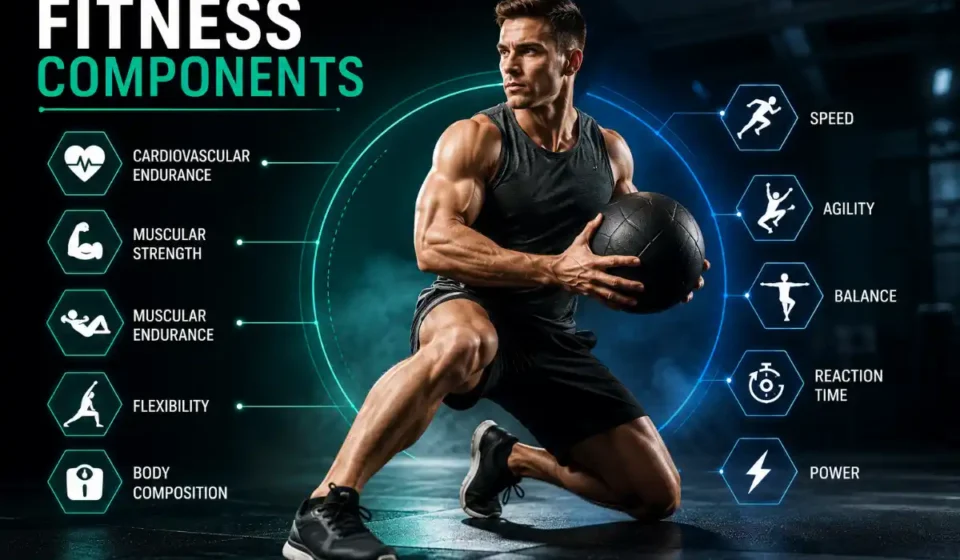

Fitness components are the specific physical qualities that describe different parts of physical fitness. For students, coaches, athletes, and people planning a general exercise routine, understanding fitness components makes it easier to see what a workout is actually developing. A useful starting point is the traditional distinction between health-related fitness and skill-related fitness, but current exercise-science guidance has evolved beyond a simple five-plus-six list.
This guide explains the major fitness components, what each one means, examples of activities that develop them, how they differ, and how to use the framework when planning training. It also explains an important 2026 update from the American College of Sports Medicine (ACSM): ACSM has highlighted a newer five-part framework that groups muscular and neuromotor qualities differently from the traditional physical-education model.
What Are Fitness Components?
Fitness components are measurable or describable physical capacities that contribute to health, physical function, movement quality, or performance. They are not separate parts of the body; rather, they are qualities that can be assessed and developed through physical activity and exercise.
The traditional physical-education model divides physical fitness into two broad groups:
- Health-related fitness components: cardiorespiratory endurance, muscular strength, muscular endurance, flexibility, and body composition.
- Skill-related fitness components: agility, balance, coordination, power, reaction time, and speed.
This traditional classification remains useful for teaching and for understanding common fitness terminology. However, it should not be presented as the only current scientific framework. ACSM’s updated framework describes five broader components: cardiorespiratory fitness; muscular fitness, including strength, endurance, and power; body composition; flexibility; and neuromotor fitness, including agility, balance, and gait speed.
That distinction matters because different textbooks, physical-education programs, and professional organizations may use different classifications. The underlying physical qualities can overlap even when the labels or grouping systems differ.
Health-Related Fitness Components
Health-related fitness focuses on qualities that support physical health and functional capacity. The traditional model contains five areas. Each can be trained and assessed in different ways, and a well-rounded program usually addresses more than one.
Cardiorespiratory Endurance
Cardiorespiratory endurance is the ability of the cardiovascular and respiratory systems to deliver oxygen to working muscles during sustained activity. Walking briskly, jogging, cycling, swimming, rowing, and hiking can all challenge this capacity.
A common laboratory measure is VO₂ max, which reflects the body’s ability to use oxygen during demanding exercise. Field or submaximal tests can also be used to estimate aerobic fitness, depending on the setting and the person’s goals. ACSM describes cardiorespiratory fitness as an important component of physical fitness and links it to the capacity of the cardiopulmonary system to deliver oxygen to working muscles.
Improving this quality generally involves regular aerobic activity with an appropriate progression in duration, intensity, or frequency. It is especially relevant to activities that require continuous effort, from everyday walking to endurance sports.
Muscular Strength
Muscular strength is the ability of a muscle or muscle group to produce force. A heavy squat, deadlift, press, or other resistance exercise can demonstrate or train strength.
Strength is useful beyond the gym. Everyday tasks such as lifting, carrying, climbing stairs, and getting up from a chair require force production. Resistance training can improve muscular strength when the exercises, loading, volume, and progression are appropriate for the individual.
A one-repetition maximum is one possible strength assessment, but it is not the only option. Submaximal testing and other standardized assessments may be more appropriate depending on the person and testing environment.
Muscular Endurance
Muscular endurance is the ability of a muscle or muscle group to continue performing repeated contractions or maintain force over time without excessive fatigue. Push-ups, repeated bodyweight squats, sustained carries, and longer-duration resistance-training sets can challenge muscular endurance.
Strength and endurance are related, but they are not interchangeable. Someone may be capable of producing high force once but struggle to repeat the effort many times. Training can be adjusted through exercise selection, resistance, repetitions, rest periods, and total workload to emphasize different muscular qualities.
The distinction is also reflected in the updated ACSM framework, which places strength, endurance, and power under the broader category of muscular fitness.
Flexibility
Flexibility refers to the range of motion available at a joint or group of joints. It can influence how comfortably a person performs movements that require a particular range of motion.
Stretching is one way to work on flexibility. Dynamic movement can be useful as part of preparation for activity, while static stretching can be used in appropriate training contexts. Yoga and other movement practices may also involve flexibility work.
Flexibility should not be treated as a guarantee against injury. Its value depends on the movement demands of the individual, and good training also requires appropriate technique, strength, workload management, and recovery. CDC guidance notes that stretching can improve joint range of motion, while flexibility work by itself should not be treated as a substitute for aerobic or muscle-strengthening activity.
Body Composition
Body composition describes the relative amounts of fat mass and fat-free components in the body. Fat-free mass includes tissues such as muscle, bone, organs, and body water.
Body weight alone cannot show how those tissues are distributed. Two people can have the same body weight while having different proportions of fat and lean tissue. Methods such as skinfold measurements, bioelectrical impedance, and DEXA can estimate body composition, although each method has limitations and different levels of accuracy.
For health and fitness planning, body composition is best considered alongside other measures rather than treated as the single definition of fitness. ACSM’s updated framework specifically identifies body composition in terms of fat mass and fat-free mass.
Read More: Fitness Components
Skill-Related Fitness Components
Skill-related fitness emphasizes movement abilities that can be especially important in sport, recreation, and tasks requiring quick or coordinated actions. The traditional model includes six components.
Agility
Agility is the ability to change body position or direction with speed and control. Cutting in soccer, changing direction in tennis, and moving around an opponent in basketball all involve agility.
Training can include planned change-of-direction drills as well as reactive drills in which the athlete responds to a visual or auditory cue. Reactive drills can be particularly useful when the direction of movement is not known in advance.
Balance
Balance is the ability to maintain equilibrium while stationary or moving. It contributes to controlled movement during activities such as gymnastics, skating, surfing, running, and everyday walking.
Balance training may include single-leg exercises, controlled changes of position, and activities that challenge stability. Balance is not only an athletic concern; it also contributes to functional movement, particularly in populations where maintaining physical function is an important goal.
CDC physical-activity guidance specifically recognizes balance training as part of multicomponent activity, particularly for older adults.
Coordination
Coordination is the ability to use sensory information and different body parts together to perform movements smoothly and accurately. Catching a ball, dribbling while scanning the court, or striking a moving object are practical examples.
Coordination improves through practice that repeatedly connects perception with movement. Sport-specific drills are useful because coordination is often highly dependent on the exact task being performed.
Power
Power describes the ability to produce force quickly. It is closely related to both strength and movement speed. Jumping, accelerating from a starting position, and throwing an object are examples of actions in which rapid force production matters.
Plyometric exercises and explosive resistance exercises can develop power when they are appropriate for the individual’s training experience and physical capacity. Power training is not simply the same as lifting the heaviest possible load; the speed and timing of force production are central to the quality.
An important update is that ACSM now places power alongside strength and endurance under muscular fitness rather than treating it only as a separate skill-related quality.
Reaction Time
Reaction time is the time required to respond to a stimulus. A sprinter reacting to a starting signal or a goalkeeper responding to a shot provides an obvious example.
Reaction time is influenced by factors such as the type of stimulus, anticipation, attention, experience, and individual characteristics. Practice can improve task-specific responses, but it would be inaccurate to suggest that everyone can eliminate the influence of biological differences through training.
Speed
Speed is the ability to move the body, or a body part, quickly. Sprinting is the clearest example, but speed can also refer to rapid movement of an arm, leg, or other body segment.
Speed training may involve short sprints, technique work, acceleration practice, and appropriately designed resisted drills. Because high-speed work can place substantial demands on the body, training volume and recovery need to match the individual’s experience and capacity.
Traditional Five and Six Fitness Components: What’s the Difference?
The traditional model is easiest to understand when the two groups are compared directly.
| Area | Health-Related Model | Skill-Related Model |
| Main purpose | Health and physical function | Movement and sport performance |
| Components | Cardiorespiratory endurance, muscular strength, muscular endurance, flexibility, body composition | Agility, balance, coordination, power, reaction time, speed |
| Typical users | General population, students, fitness professionals | Athletes, coaches, physical-education students, active individuals |
| Examples | Brisk walking, resistance training, stretching, aerobic exercise | Change-of-direction drills, jumping, sprinting, reaction drills |
| Main emphasis | Capacity that supports health and daily function | Efficient, rapid, controlled movement |
Read More: Fitness Components
The distinction is useful, but the categories are not completely isolated. An athlete needs cardiorespiratory and muscular fitness to train effectively, while balance and coordination can matter in ordinary daily activities.
ACSM’s updated framework also demonstrates why different sources may present different lists. Rather than treating the traditional model and the newer framework as competing definitions, it is more useful to understand what each framework is designed to describe.
The Updated ACSM Framework for Fitness
A major freshness issue matters for anyone publishing this topic in 2026. Older resources often state that there are exactly five health-related and six skill-related components as though that is the current universal scientific classification. That wording is now too rigid.
In August 2026, ACSM reported a new roundtable statement describing five updated components of physical fitness:
- Cardiorespiratory fitness
- Muscular fitness, including strength, endurance, and power
- Body composition, including fat mass and fat-free mass
- Flexibility
- Neuromotor fitness, including agility, balance, and gait speed
ACSM describes this as an updated, evidence-based framework for understanding physical fitness.
This framework does not make the traditional physical-education model useless. Instead, it provides a newer way to organize related physical qualities. For a school assignment, the terminology used by the curriculum or textbook should take priority. For a general fitness article, it is more accurate to explain both the traditional educational model and the newer ACSM framework.
How to Train Different Fitness Components
A practical fitness program does not need a completely separate workout for every component. Many exercises develop several qualities at the same time.
- Cardiorespiratory fitness: walking, jogging, cycling, swimming, rowing, or other sustained aerobic activities.
- Muscular strength: progressive resistance exercises such as squats, presses, rows, and deadlift variations.
- Muscular endurance: repeated resistance movements, circuits, carries, and longer-duration sets.
- Flexibility: appropriately selected stretching and mobility work.
- Body composition: regular physical activity combined with nutrition and overall lifestyle habits; body composition should be evaluated in context rather than through body weight alone.
- Agility: change-of-direction and reactive movement drills.
- Balance: single-leg and stability-focused exercises.
- Coordination: skill practice that combines perception with precise movement.
- Power: appropriately scaled jumps, throws, and explosive resistance exercises.
- Reaction time: drills that require a rapid response to a predictable or changing cue.
- Speed: short sprint efforts, acceleration work, and technique practice.
Training should reflect the person’s goal. A recreational runner may prioritize aerobic fitness and muscular endurance, while a basketball player may place greater emphasis on acceleration, power, agility, coordination, and repeated-effort capacity. Someone focused on general health can use a broader combination.
There is also no need to isolate every quality into a separate training day. A well-designed session can develop several areas at once. For example, resistance training can address strength and muscular endurance, while sport-specific drills can combine speed, agility, balance, and coordination.
Read More: Fitness Components
Why Fitness Components Matter
Knowing the components of fitness helps turn the vague goal of “getting fit” into measurable qualities. Instead of simply adding more exercise, a person can ask what the program is trying to improve.
For example, a routine containing only long-distance running may improve cardiorespiratory fitness but provide less direct emphasis on muscular strength or power. A strength-only program may build force production while giving less attention to aerobic capacity or movement skills. A balanced plan can therefore be more useful than repeatedly training the same quality.
The broader health picture also matters. Current U.S. physical-activity guidance recommends that adults accumulate 150 to 300 minutes of moderate-intensity aerobic activity per week, or 75 to 150 minutes of vigorous activity, or an equivalent combination, along with muscle-strengthening activity on at least two days per week. These are physical-activity recommendations, not a requirement to train every individual fitness component separately.
For older adults, guidance also emphasizes multicomponent activity that includes balance alongside aerobic and muscle-strengthening activity. This illustrates why fitness should be viewed as a combination of capacities rather than a single number.
How to Assess Fitness Components
Assessment should match the component being measured and the person’s circumstances.
- Cardiorespiratory fitness: laboratory or field-based aerobic tests, including VO₂-related assessments.
- Muscular strength: standardized maximal or submaximal resistance tests.
- Muscular endurance: repeated-movement tests or sustained muscular tasks.
- Flexibility: joint-specific range-of-motion assessments or standardized flexibility tests.
- Body composition: methods such as DEXA, skinfold assessment, or bioelectrical impedance.
- Agility: planned or reactive change-of-direction tests.
- Balance: static or dynamic balance assessments.
- Coordination: task-specific movement tests.
- Power: jumping, throwing, or other explosive performance tests.
- Reaction time: standardized response-to-stimulus tests.
- Speed: timed short-distance movement tests.
ACSM’s current fitness-assessment resources organize assessment around areas such as body composition, cardiorespiratory fitness, muscular fitness, and flexibility, reinforcing the importance of matching the assessment method to the physical quality being evaluated.
No single test captures overall fitness. A result is meaningful only when the test is appropriate, performed consistently, and interpreted in the context of the individual’s age, experience, goals, and health status.
Common Mistakes When Understanding Fitness Components
One common mistake is treating fitness as synonymous with appearance. Body composition is one component, but it does not replace cardiorespiratory fitness, muscular fitness, flexibility, or movement ability.
Another mistake is assuming that athletic performance and health are the same thing. Someone can be highly skilled at a sport without having every health-related quality optimized, while a person can have good general fitness without being fast, agile, or highly coordinated in a particular sport.
A third mistake is assuming that every component must be trained equally. Training priorities should reflect the person’s goals. A component deserves more attention when it is important to the activity being performed or when assessment shows that it is a meaningful limitation.
Finally, avoid treating one classification as the only valid terminology. Traditional physical-education resources and newer professional frameworks can organize the same physical qualities differently.
Frequently Asked Questions
What are the five components of fitness?
In the traditional health-related model, the five components are cardiorespiratory endurance, muscular strength, muscular endurance, flexibility, and body composition. Current ACSM guidance uses a newer five-component framework that combines some muscular and neuromotor qualities differently.
How many skill-related fitness components are there?
The traditional skill-related model has six: agility, balance, coordination, power, reaction time, and speed. Newer frameworks may group or label these qualities differently.
What is the difference between health-related and skill-related fitness?
Health-related fitness focuses mainly on qualities associated with health and physical function. Skill-related fitness focuses on movement qualities that are particularly relevant to sport and coordinated performance.
Which fitness component is most important?
There is no single component that is most important for everyone. Priorities depend on whether the goal is general health, daily function, a particular sport, or a specific physical task.
Can fitness components be improved with training?
Yes. Most components can be developed through appropriately designed exercise and practice. The amount and type of improvement depend on the component, training history, consistency, recovery, and individual characteristics.
Is body composition the same as body weight?
No. Body weight is the total mass of the body, while body composition describes how that mass is distributed among fat mass and fat-free components such as muscle, bone, organs, and water.
What tests measure health-related fitness?
Common approaches include aerobic fitness tests for cardiorespiratory capacity, resistance-based tests for strength and endurance, range-of-motion tests for flexibility, and body-composition assessments. The appropriate test depends on the person and setting.
Do athletes need both health-related and skill-related fitness?
Usually, yes. Athletic performance depends on a combination of physical capacities and sport-specific skills. The exact balance varies by sport, position, event, and athlete.
How often should you train each fitness component?
There is no universal schedule that requires every component to be trained separately. A balanced program can combine aerobic activity, resistance training, mobility or flexibility work, and sport- or goal-specific movement practice across the week.
Why do different sources list different fitness components?
Because different organizations and educational systems use different classification frameworks, the traditional five health-related plus six skill-related model remains common in physical education, while ACSM’s 2026 roundtable statement presents an updated five-component framework. Always use the framework required by your course or professional context.