
If you’ve ever pressed on the center of your chest just below your ribs and felt a small, hard bump, you’ve found your xiphoid process. This guide walks through what it is, why it exists, and how to make sense of the tenderness, swelling, or lump that sometimes shows up in this spot.
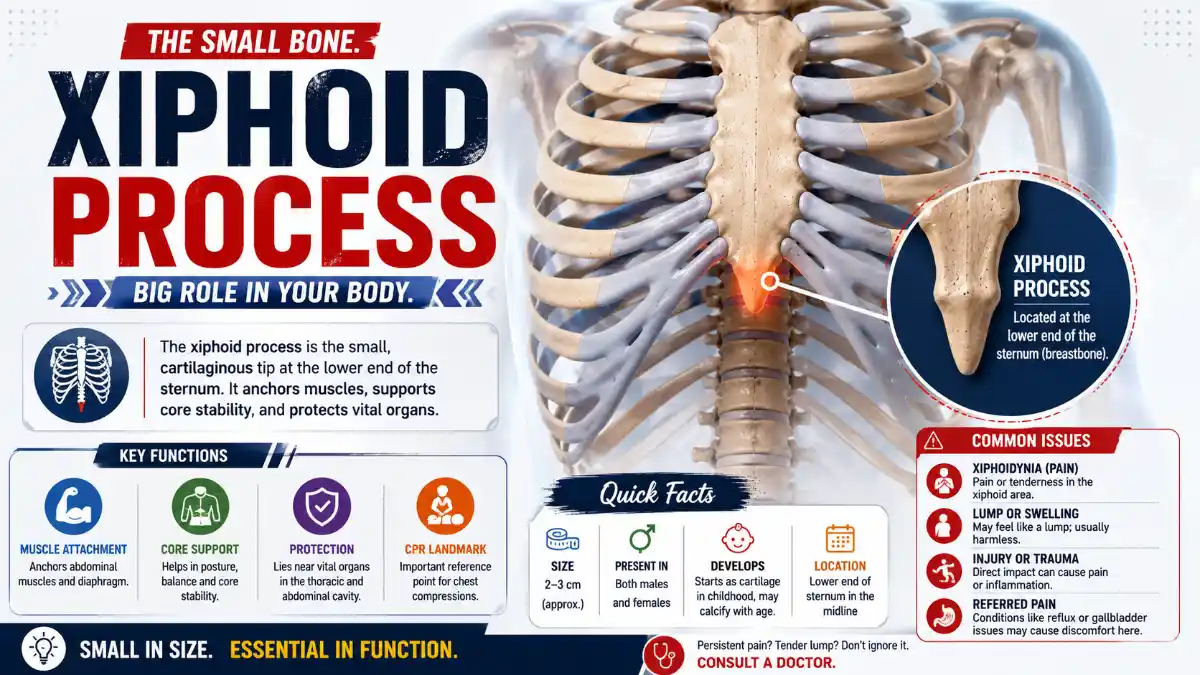
In short: the xiphoid process is the small, lowest segment of the sternum (breastbone), located at the center of the chest where the lower ribs meet, just above the upper abdomen. It begins as cartilage in infancy and gradually ossifies into bone with age, and its size and shape vary considerably from person to person, which is why it can feel like a distinct hard bump in some people and barely be noticeable in others. Tenderness or soreness in this area can result from muscle strain, minor trauma, mechanical pressure, or irritation around this joint, but pain that is severe, persistent, or accompanied by breathing difficulty should always be medically evaluated rather than assumed to be harmless.
Quick Facts at a Glance
| Question | Short Answer |
| What is it? | The lowest, smallest segment of the sternum (breastbone) |
| Where is it? | Center of the chest, just above the upper abdomen, roughly level with the tenth thoracic vertebra |
| What is it made of? | Cartilage at birth, gradually ossifying into bone with age |
| How big is it? | Roughly 2 to 5 cm long in adults |
| What does it attach to? | Abdominal muscles, the diaphragm, and rib cartilage, via the xiphisternal joint |
| Common symptom | Tenderness, prominence, or a firm “bump” feeling at the base of the sternum |
| When to worry | Sudden severe pain, breathing difficulty, or a rapidly growing mass |
Read More: Xiphoid
Anatomy in Plain Terms
The sternum has three stacked segments: a wide upper plate (the manubrium), a long middle shaft (the sternal body), and finally the xiphoid process – a narrow tip pointing downward toward the abdomen and joined to the sternal body above it by the xiphisternal joint. It’s the smallest of the three segments, and unlike the other two, it starts life as soft cartilage rather than bone.
That cartilage gradually converts to bone over decades, beginning in early childhood but often not completing until well into adulthood, with substantial variation between individuals. Because of this uneven hardening, its shape ends up highly individual: it can range from a straight point to a curved, forked, or perforated tip. None of these variations are considered abnormal on their own; clinicians reviewing scans are trained to recognize normal variants rather than mistake them for tumors or fractures.
Locating the Xiphoid Process
Finding it takes only a few seconds:
- Place a finger at the top of your breastbone, near the base of your throat.
- Slide your finger straight down the center of your chest.
- Stop where the bone ends in a small point or notch, just above your upper abdomen.
- Press gently – you should feel a firmer, more defined edge compared to the soft tissue around it.
People with a leaner build or less chest fat often notice this landmark more easily, and it can become more prominent after weight loss.
Muscles and Ligaments It Anchors
This small structure doesn’t move independently; instead, it serves as an attachment point for several important muscles and ligaments, which is central to its function:
- The rectus abdominis, the vertical abdominal muscle, attaches near its base
- Aponeuroses (connective tissue sheets) from the oblique abdominal muscles pass across it
- Fibers of the diaphragm attach along its posterior surface
- The transversus thoracis, a thin chest wall muscle, connects here
- Costoxiphoid ligaments, formed with the seventh rib’s cartilage, help stabilize the lower rib cage
A Landmark Surgeons and Rescuers Rely On
Beyond its structural role, this area is a practical reference point in emergency and surgical medicine. Current American Heart Association resuscitation guidance directs rescuers to compress the lower half of the sternum, centered on the chest, while staying above the xiphoid tip rather than on it, since compressing this bone directly can fracture it and potentially injure the liver underneath. For complete, up-to-date CPR technique, refer to official training materials rather than a general anatomy guide.
In surgery, the region just below this tip – the subxiphoid area – is sometimes used as an access point for procedures involving the pericardium or chest cavity, since it can offer a route into the chest without cutting through rib bone. This is a specialized decision made by a treating physician and isn’t relevant to typical self-care.
What Causes Xiphoid Process Pain?
Pain or tenderness at the base of the sternum can result from one or more overlapping causes:
- Mechanical strain from heavy lifting, intense core exercise, repetitive twisting, or a prolonged coughing fit, which stresses the muscle and ligament attachments described above
- Direct trauma, such as a fall, sports injury, or steering-wheel impact, which can bruise or, less commonly, fracture the bone
- Mechanical pressure from tight waistbands, seatbelts, compression garments, or leaning body weight onto the area
- Xiphodynia, an uncommon condition involving irritation of the xiphoid or its joint (covered below)
- Costochondritis, inflammation of nearby rib cartilage that can radiate pain toward this area
Pain can also simply be felt in this region without originating there – conditions such as reflux, gallbladder disease, and cardiac disease can all produce discomfort that overlaps with this part of the chest, which is why persistent or unclear pain deserves a clinical evaluation rather than a home diagnosis.
Xiphodynia: When This Area Itself Is the Source
Xiphodynia (also called xiphoidalgia) describes pain that genuinely originates from irritation of the xiphoid process or its joint, rather than pain that’s merely felt nearby. It’s considered uncommon and easy to miss, since the discomfort can radiate toward the chest, upper stomach, throat, or arms – a pattern that overlaps with several more serious conditions, including coronary ischemia.
Findings that can support a musculoskeletal cause include:
- Tenderness that intensifies with direct pressure on the tip itself
- Pain that shifts with bending, twisting, or lying face-down
- A history of recent heavy lifting, chest trauma, or repetitive strain
Importantly, pain reproduced by pressing on this area can support a musculoskeletal cause, but it does not by itself rule out heart, lung, gastrointestinal, or other causes of chest or upper-abdominal pain. Xiphodynia is a diagnosis made only after more dangerous causes have been reasonably excluded.
Because xiphodynia is uncommon, most of the available treatment evidence comes from case reports and small case series, and there is no universally established treatment protocol. In general, care progresses from conservative management (rest, activity modification) to clinician-directed local injections for persistent cases, with xiphoidectomy – surgical removal of the affected bone – reserved for rare, confirmed cases that don’t respond to anything else.
How Xiphodynia Is Diagnosed
There is no single test that confirms this condition; it’s a diagnosis of exclusion. A clinician typically takes a history of onset, triggers, and any recent trauma, then performs a physical exam, checking whether direct pressure reproduces the pain. Before settling on this diagnosis, they work to rule out cardiac causes (such as angina or a heart attack), pulmonary causes (such as a blood clot in the lung), and gastrointestinal causes (such as reflux, ulcers, or gallbladder disease), since all of these can produce a similar pain pattern. Testing such as an ECG, blood work, or imaging may be used depending on the individual’s symptoms and risk factors, at the clinician’s discretion.
Chest and Upper-Abdominal Pain: Common Differences
Symptoms overlap substantially between these conditions, and this table cannot rule any of them in or out. Whether a symptom needs emergency evaluation depends on the full clinical picture, not on the underlying label alone.
| Condition | Reproduced by pressing the area | Typical trigger | Potential urgency |
| Xiphodynia | Often | Strain, trauma, repetitive pressure | Usually non-emergency, after other causes excluded |
| Costochondritis | Often | Chest wall strain, viral illness | Usually non-emergency |
| GERD / peptic ulcer disease | Rarely | Meals, lying down | Usually non-emergency |
| Gallbladder disease | Rarely | Fatty meals | Depends on presentation |
| Pericarditis | Rarely | Recent viral illness; worse lying flat | Can require emergency evaluation |
| Pulmonary embolism | No | Sudden onset, breathlessness | Can require emergency evaluation |
| Coronary ischemia (angina/heart attack) | No | Exertion or stress; can occur at rest | Can require emergency evaluation |
Read More: Xiphoid
Self-Check: When to Escalate Care
This isn’t a substitute for a medical opinion, and reproducing pain by pressing on the area does not exclude a serious cause. Use these questions only to decide how urgently to seek care:
- Are you having sudden or severe chest or upper-abdominal pain with shortness of breath, chest pressure or tightness, unexplained sweating, fainting or severe dizziness, or pain spreading to the arm, jaw, neck, or back? Seek emergency medical care right away.
- Does pressing on the spot reproduce the exact pain, and does it change with breathing or posture? This can support – but not confirm – a musculoskeletal cause.
- Has the pain lasted more than two to three weeks without improvement? If so, schedule a medical evaluation regardless of how mild it feels.
Normal Prominence vs. a New Mass
A firm midline bump at the lower end of the sternum may simply reflect a prominent or normally shaped xiphoid process, particularly if it has been stable over time and becomes more noticeable after weight loss or during pregnancy, when the growing uterus pushes against the lower ribcage. Infants and young children normally have a highly cartilaginous, sometimes visibly protruding tip, which is a routine pediatric finding rather than a cause for concern.
A lump that looks different from this baseline – one that is new, growing over weeks, unusually hard or fixed in place, or accompanied by skin discoloration or fever – falls outside typical prominence and should prompt a clinical exam.
How Doctors Evaluate This Kind of Pain or Swelling
Evaluation usually starts with a history and physical exam, including palpation to check tenderness and rule out red-flag findings. Imaging isn’t routinely needed for typical, stable prominence or mild strain-related soreness. It’s more likely to be considered for significant trauma, a rapidly changing or unclear mass, suspected fracture, or when symptoms don’t fit a clear pattern – in which case an X-ray, ultrasound, or CT scan can help clarify the anatomy or rule out other causes.
Red Flags: Don’t Wait to Get Checked
Contact a doctor promptly, or seek emergency care if pain is severe or sudden, in the presence of any of the following:
- Shortness of breath, chest tightness, or a sense of pressure
- Sweating, fainting, or severe dizziness alongside chest discomfort
- Pain spreading into the jaw, neck, back, or left arm
- A lump that appeared suddenly or is growing quickly
- Pain following a significant fall, car accident, or direct blow to the chest
- Fever accompanying chest wall tenderness
Managing Confirmed Musculoskeletal Pain in This Area
Management depends on the diagnosed cause; the measures below are intended only for symptoms that a clinician has already assessed as musculoskeletal, not as a substitute for that evaluation. For milder, ongoing tenderness that fits this description, a few daily adjustments can reduce irritation:
- Loosen tight waistbands, seatbelts, or compression garments that press directly on the area
- Avoid resting your forearms or leaning your body weight onto the spot
- Sleep on your back or side rather than face-down if that position triggers discomfort
- Apply a cold pack for recent strain, or gentle heat for longer-standing tightness, based on what feels better
Final Thoughts
The xiphoid process is a small structure with an outsized role – anchoring core muscles, guiding CPR technique, and occasionally becoming a genuine, if under-recognized, source of chest wall pain through xiphodynia. Most tenderness or prominence in this area is explainable by strain, weight change, or normal anatomy, but it shares symptom territory with several more serious conditions. Pain paired with breathing trouble, a fast-growing lump, or discomfort that won’t ease after a few weeks is the signal to move from self-observation to a medical evaluation, since reproducing tenderness by pressing on the area supports – but never confirms – a benign cause.
Frequently Asked Questions
Is a protruding xiphoid process normal?
Yes, in most cases. A protruding or curved tip is usually a normal anatomical variation, and shape and angulation vary considerably between individuals. It becomes worth checking only if it’s linked to new pain, follows a recent injury, or is mistaken for an abnormal mass, in which case a clinician can confirm through exam or imaging that it’s a normal variant.
What causes xiphoid process pain?
Common causes include mechanical strain from heavy lifting or intense core exercise, direct trauma from a fall or impact, pressure from tight clothing, and xiphodynia, a condition involving irritation of the xiphoid or its joint. Costochondritis and, less directly, conditions like reflux or gallbladder disease can also produce pain felt in the same region. Persistent, severe, or unclear pain should be evaluated by a clinician rather than self-diagnosed.
Can the xiphoid process become swollen?
This bone doesn’t typically “swell” in the way soft tissue does, but the area can become more prominent or feel firmer following weight loss, pregnancy, or minor trauma that causes localized soft-tissue swelling around it. A true, rapidly growing, or hard mass is not typical of ordinary prominence and should be examined by a doctor.
Can the xiphoid process break?
Yes, although uncommon, it can fracture or bruise from a direct blow, such as a fall, a car accident, or forceful chest compressions during CPR. Signs include sharp, localized pain that worsens with pressure, coughing, or deep breathing, sometimes with visible swelling. Because the area sits close to the liver and diaphragm, suspected fractures from significant trauma should be evaluated promptly rather than managed at home.
What does xiphoid process pain feel like?
Pain from strain, trauma, or xiphodynia is usually described as localized soreness or sharp tenderness at the base of the sternum that worsens with direct pressure, bending, twisting, or deep breathing. This differs from the burning quality more typical of reflux or the pressure-like, exertion-related quality often associated with cardiac pain, though overlap between these patterns is common enough that self-diagnosis isn’t reliable.
How is xiphodynia diagnosed?
It’s diagnosed by exclusion: a clinician takes a history, examines whether pressing on the area reproduces the pain, and rules out cardiac, pulmonary, and gastrointestinal causes that can produce a similar pattern. There’s no single confirmatory test, so testing such as an ECG, blood work, or imaging may be used selectively based on the individual’s symptoms and risk factors before this diagnosis is made.
What kind of doctor evaluates xiphoid pain?
A primary care physician is typically the first point of contact and can assess whether the pain is musculoskeletal or needs further workup. Depending on findings, they may refer to a cardiologist to rule out heart-related causes, a gastroenterologist for suspected digestive causes, or an orthopedic or pain specialist for confirmed, persistent xiphodynia that doesn’t respond to conservative care. Sudden severe symptoms should go to emergency care rather than waiting for a specialist referral.
Can pregnancy make the xiphoid process more prominent or painful?
Yes. As the uterus grows during later pregnancy, it can push upward against the lower ribcage and put outward pressure on this part of the sternum, making it feel more prominent or tender. This is a common and generally harmless change that tends to ease after delivery once the pressure on the ribcage resolves. Persistent or severe pain in this area during pregnancy should still be mentioned to a healthcare provider.
Does deep breathing or coughing make xiphoid process pain worse?
It can, particularly when the pain stems from a musculoskeletal cause such as strain, costochondritis, or xiphodynia, since these movements stretch or engage the muscles and cartilage attached to this part of the chest. Pain that worsens specifically with breathing or coughing, without other red-flag symptoms, often points toward a chest-wall origin rather than a cardiac one, though this pattern alone isn’t enough to confirm the cause.
How long does xiphoid process pain from a minor strain usually last?
Pain from mild strain or minor bruising generally eases gradually as the underlying tissue heals, though the exact pace varies with the severity of the injury and individual healing. Reducing the activity that triggered the pain and avoiding pressure on the area typically supports recovery. Pain that persists beyond a few weeks, worsens, or doesn’t respond to rest should be reassessed by a clinician rather than assumed to be resolving on its own.