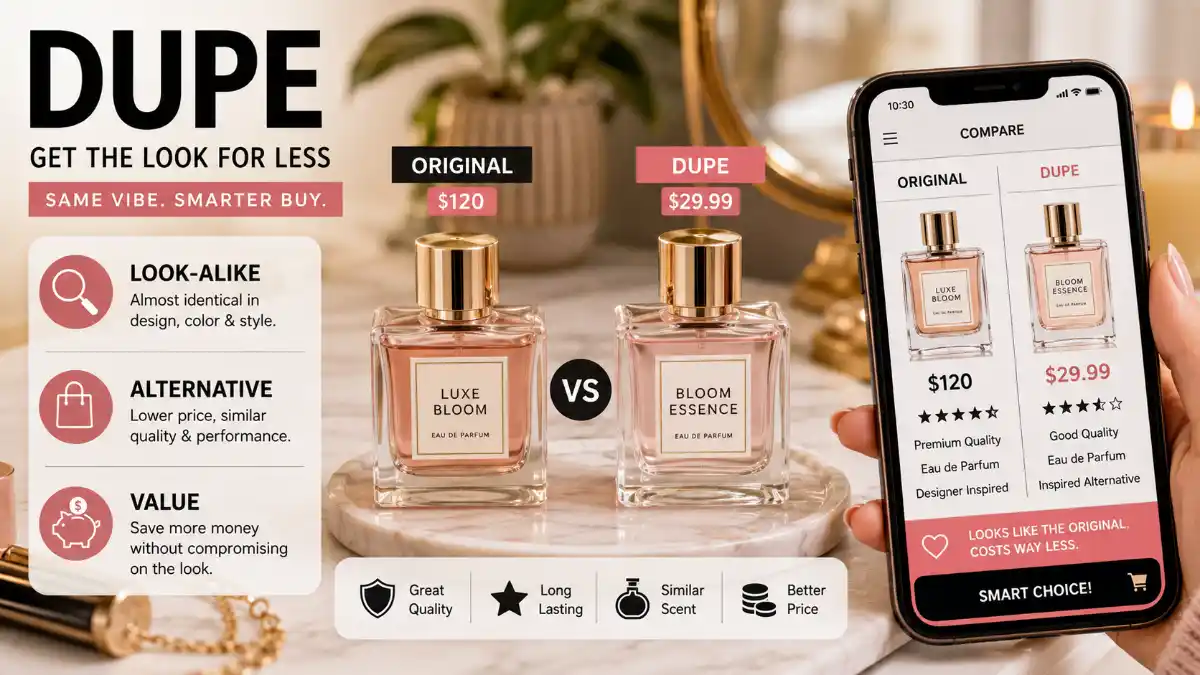

A dupe can be a smart way to get a similar look, finish, scent, or function without paying the price of a premium product. But not every affordable alternative deserves the label. Some are genuinely good substitutes, while others simply copy the appearance of a popular item and cut too many corners on ingredients, materials, construction, or performance.
This guide explains dupe meaning, how to evaluate dupe products, where beauty and fashion alternatives differ, how to spot counterfeit warning signs, and what to check before buying an affordable alternative online.
What Does Dupe Mean?
A dupe is generally an independently branded product that offers a similar appearance, function, style, scent, or overall experience to a more expensive or well-known product. The important distinction is that the alternative is sold as its own product rather than being presented as the original.
For example, a lipstick may be considered a dupe if it has a similar shade, finish, and wear profile to a much more expensive lipstick. A handbag may be described this way when it captures a similar silhouette or styling without using the original designer’s branding.
The term is informal rather than a universal legal classification. Whether a particular product is lawful can depend on factors such as trademarks, packaging, product design, trade dress, advertising, and the laws of the country involved. A trademark can include words, symbols, designs, or combinations that identify the source of goods, so simply removing a logo does not automatically make every imitation legally risk-free.
In practical shopping terms, the easiest distinction is:
- Dupe: An alternative product sold under its own brand and identity.
- Counterfeit: A product presented as genuine or made to reproduce protected branding or identifying elements without authorization.
- Inspired-by product: A broad marketing description that may indicate similarity but does not, by itself, prove comparable quality or performance.
That distinction matters because shoppers should evaluate an alternative for what it actually delivers rather than assuming that visual similarity means identical quality.
How to Evaluate a Dupe Before Buying
The best way to judge an affordable alternative is to compare the things that matter for the specific product. Price alone is not enough.
1. Compare the actual price difference
Start by calculating how much you are saving.
If the original costs $100 and the alternative costs $35, the lower price may make a meaningful quality trade-off worthwhile. If the original is $40 and the alternative is $32, however, the small saving may not justify accepting weaker materials, fewer features, or a less convenient return policy.
Also consider the total cost, not just the listed price. Shipping, taxes, returns, replacement costs, and accessories can change the value equation.
A cheaper item is only a better deal when the reduction in price outweighs the differences in quality and ownership experience.
2. Compare ingredients or materials
This is especially important for beauty products and clothing.
For skincare, compare the ingredient lists and the product’s intended purpose rather than relying on phrases such as “luxury alternative” or “inspired by.” Similar ingredients do not automatically mean identical concentrations, formulation, stability, texture, or performance.
For fashion, check the fiber composition, lining, hardware, stitching, fabric weight, and construction. A garment that looks like a designer piece in a product photograph can feel completely different when worn if the fabric, structure, or finishing is substantially different.
3. Check real-world reviews
Look for repeated patterns rather than one enthusiastic review.
Useful review signals include:
- Sizing problems
- Color differences from product photos
- Fabric or material quality
- Peeling, fading, or cracking
- Poor stitching
- Weak zippers or closures
- Short wear time
- Irritation or sensitivity reports for cosmetics
- Packaging or delivery problems
- Difficult returns
Recent reviews are particularly useful for products that manufacturers may reformulate, discontinue, resize, or redesign.
4. Examine construction and finish
Marketing photographs can hide inexpensive construction.
For fashion, inspect seams, stitching, hems, lining, buttons, zippers, handles, and hardware. For accessories, pay attention to weight and the way moving parts operate.
For beauty products, inspect the packaging, seal, applicator, texture, scent, and labeling. A low price does not automatically indicate poor quality, but unexplained inconsistencies deserve caution.
5. Check the seller
The product itself is only one part of the purchase.
Before ordering, check:
- Who actually sells the item
- Whether the seller provides clear product information
- Whether the retailer has a usable return policy
- Whether customer reviews appear consistent
- Whether the product has the expected labeling
- Whether the listing makes unusually strong authenticity claims
A legitimate-looking product can still be a poor purchase when the seller provides little information or makes it difficult to return defective merchandise.
Read More: Dupe
Beauty Dupes: What Matters Most?
Beauty alternatives require a more careful comparison because appearance is only one part of performance. A product can look similar while behaving differently on skin, hair, lips, or nails.
Skincare
For skincare, start with the ingredient list and intended use.
Look at the major ingredients, product type, texture, fragrance, and stated purpose. Do not assume that two products will perform identically merely because several ingredients appear in both formulas.
Cosmetic ingredient labels are useful because ingredients are generally listed by their common or usual names and, in the United States, are generally listed in descending order of predominance, subject to specific labeling rules.
Safety is another reason not to treat ingredient similarity as proof of equivalence. Cosmetic products sold in the United States generally do not receive FDA premarket approval, with important exceptions such as certain color additives; manufacturers and marketers remain responsible for product safety and labeling.
If a new skincare product irritates, stop using it and follow the product’s safety directions. People with known sensitivities should pay particular attention to the complete ingredient list rather than relying on labels such as “natural” or “hypoallergenic.” FDA notes that “hypoallergenic” does not have a formal FDA definition.
Makeup
For makeup, compare more than shade.
A useful comparison includes:
- Shade accuracy
- Coverage
- Finish
- Blendability
- Wear time
- Transfer resistance
- Oxidation
- Texture
- Applicator or packaging
- Performance on your skin type
A foundation that matches the original shade but breaks down much faster is not necessarily a strong alternative. Similarly, an eyeshadow palette with similar colors may still differ significantly in pigmentation and blendability.
For makeup, “looks the same” and “performs the same” are separate claims.
Fragrance
Fragrance alternatives are particularly subjective.
Two scents can have a similar overall impression while differing in opening notes, development, projection, and longevity. Skin chemistry can also affect how a fragrance develops.
When evaluating fragrance alternatives, compare the scent at different stages rather than judging it immediately after application. If possible, test a sample before committing to a larger bottle.
A product marketed as “inspired by” a popular fragrance should not automatically be treated as an exact duplicate. The useful question is whether its scent profile and performance meet your expectations at its price.
Hair and body products
For shampoos, conditioners, body lotions, cleansers, and similar products, compare the intended use, formulation, fragrance, texture, and ingredient list.
A lower-priced product may be a good choice if it delivers the result you want. But a similar fragrance or packaging style does not demonstrate equivalent performance.
Read More: Dupe
Fashion Dupes: What to Check Before You Buy
Fashion alternatives are often judged visually, but appearance is only one part of the equation.
A useful comparison starts with the silhouette. Does the garment or accessory actually have a similar shape, proportions, and styling? After that, examine the construction.
Fabric and material
Check the fiber composition rather than relying on descriptions such as “premium feel.”
A jacket made largely from synthetic fibers may have a similar silhouette to a wool garment but will behave differently in warmth, drape, breathability, and durability.
The same principle applies to handbags and shoes. Look at the listed material, lining, hardware, soles, closures, and other construction details.
Fit and sizing
Sizing is one of the biggest reasons a visually convincing alternative can disappoint.
Do not assume that the size of the original will translate directly to another retailer. Compare the actual measurements provided by the seller, particularly for:
- Bust
- Waist
- Hips
- Inseam
- Shoulder width
- Garment length
- Shoe measurements
For structured clothing, measurements can be more useful than labels such as S, M, or L.
Construction
Look closely at areas that receive repeated stress.
For clothing, examine seams, hems, buttons, zippers, and lining. For bags, inspect handles, stitching, closures, and hardware. For shoes, look at the sole construction, stitching, cushioning, and material.
A cheaper product does not need to match the original in every detail to be worthwhile. It simply needs to deliver enough quality for the way you intend to use it.
Dupe vs. Counterfeit: Know the Difference
The most important warning sign is misleading branding.
| Feature | Legitimate alternative | Counterfeit warning |
| Brand name | Uses its own brand identity | Uses the original brand’s name without authorization |
| Logo | Uses its own logo | Copies the original logo |
| Product description | Clearly describes the product as its own | Claims or strongly implies it is the genuine original |
| Packaging | Has its own packaging identity | Closely imitates branded packaging to create confusion |
| Seller claims | Makes realistic comparisons | Makes unsupported authenticity claims |
| Product identity | Sold as an alternative | Presented as the genuine branded product |
The distinction is not always as simple as “same design versus different design.” Trademark and design protections can cover different elements, and laws vary between jurisdictions. EUIPO, for example, recognizes that product appearance can receive design protection when legal requirements are met.
For shoppers, the safest practical rule is simple: never buy an item that is being presented as an authentic branded product when the seller cannot establish that authenticity.
Where to Find the Best Dupes
The best dupes are usually found by comparing products rather than blindly following viral recommendations.
Social media can be useful for discovering alternatives because creators can demonstrate side-by-side differences in appearance, color, fit, or application. But viral popularity is not proof of quality.
Use social content as a starting point, then verify the product independently.
Check:
- The current product listing
- Recent customer reviews
- Ingredients or materials
- Sizing information
- Return policy
- Seller reputation
- Actual price
- Whether the product is still available
This process is particularly important because beauty and fashion products change frequently. A recommendation that was accurate several months ago may no longer describe the current formula, color, material, sizing, or availability.
Are Affordable Dupes Actually Worth It?
Sometimes, yes. But the answer depends on what you are trying to reproduce.
If your priority is appearance, an affordable alternative may provide excellent value even if the material or construction is different.
If your priority is performance, you need to compare the features that actually produce the result.
If your priority is longevity, a slightly more expensive alternative may make more sense than the cheapest option available.
Think of the purchase as a trade-off:
| Your priority | What to compare |
| Appearance | Shape, color, finish, silhouette |
| Performance | Function, coverage, wear, effectiveness |
| Durability | Materials, construction, stitching, hardware |
| Safety | Labeling, ingredients, directions, seller information |
| Value | Price, quality, longevity, return policy |
| Authenticity | Branding, seller claims, product identity |
The goal is not to find something that is identical in every possible way. The goal is to decide whether the differences matter to you.
Common Mistakes People Make When Buying Dupes
One common mistake is treating a viral recommendation as a guarantee.
A creator may genuinely like a product, but personal preferences, skin type, body shape, climate, and expectations can produce very different results.
Another mistake is comparing only the price. A $20 product is not automatically better value than a $50 product if it needs to be replaced repeatedly.
A third mistake is ignoring the return policy. This matters especially for clothing, shoes, foundation shades, and products where fit or color cannot be judged accurately from photographs.
Finally, shoppers sometimes confuse similar appearance with equivalent performance. Those are two different standards, and the difference is often where the biggest disappointment occurs.
A Simple Checklist Before Buying a Dupe
Before placing an order, ask:
- Does the product use its own brand identity?
- What exactly am I trying to replicate: appearance, function, material, scent, or performance?
- How large is the price difference?
- Have I checked the actual ingredients or materials?
- Are recent reviews consistent?
- Does the seller provide clear product information?
- Can I return it if the fit, color, or quality is wrong?
- Are there signs that the listing is pretending to be authentic?
- Am I accepting a quality trade-off knowingly?
- Would I still consider it a good purchase if the original product did not exist?
That final question is surprisingly useful. It forces you to judge the alternative as a product in its own right instead of giving it extra credit simply because it resembles something expensive.
Frequently Asked Questions
What is the meaning of dupe in shopping?
In shopping, a dupe usually means an independently branded product that offers a similar look, function, style, scent, or overall experience to another, often more expensive product. It is commonly used for beauty, fashion, accessories, and consumer products.
Are dupes the same as counterfeits?
No. A legitimate alternative is generally sold under its own branding, while a counterfeit attempts to pass itself off as the genuine branded product or uses protected branding without authorization. The exact legal distinction depends on the facts and applicable jurisdiction.
How can I tell if a product is a legitimate dupe?
Start with the branding and product listing. A legitimate alternative should identify itself as its own product rather than falsely claiming to be the original. Also check the seller, packaging, product information, and authenticity claims.
Are beauty dupes safe?
You should not assume that a beauty alternative is safe simply because it resembles a popular product or uses similar ingredients. Check the complete label, follow the manufacturer’s directions, and consider your own sensitivities. Ingredient similarity does not establish identical formulation or safety.
Are ingredient-matched skincare products identical?
No. Two products can contain some of the same ingredients while differing in concentrations, formulation, texture, stability, preservatives, fragrance, and overall performance.
Why are fashion alternatives often cheaper?
Lower prices can result from differences in materials, construction, manufacturing scale, branding, retail overhead, design development, or other costs. A similar appearance does not reveal which of those differences exist in a particular product.
Do the best dupes always cost less?
Not necessarily. A product can be inexpensive and still offer poor value if it wears out quickly or performs badly. The better comparison is the relationship between price, quality, performance, durability, and your intended use.
Should I trust viral dupe recommendations?
Use them for discovery, not as proof. Check recent reviews, current product information, materials or ingredients, seller details, and return policies before buying. Viral recommendations can become outdated as products change or disappear.
Can a dupe be better than the original?
It can be better for a particular shopper in a particular respect, such as price, accessibility, fit, or a feature that the shopper prefers. That does not mean it is universally better, because the original and alternative may prioritize different qualities.
What should I compare first when choosing a dupe?
First decide what you actually want to reproduce: appearance, performance, material, scent, function, or price-to-performance value. Then compare the specific characteristics that determine that outcome. This is more reliable than judging a product from its appearance alone.