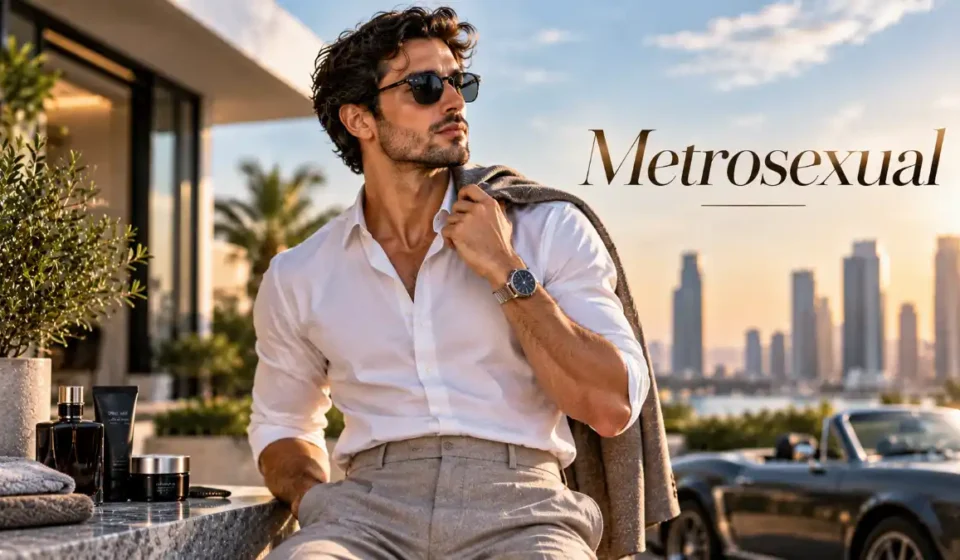

The term metrosexual describes a man traditionally associated with strong attention to personal appearance, fashion, grooming, skincare, and lifestyle. The word became especially prominent in the early 2000s, when changing ideas about masculinity, celebrity culture, advertising, and men’s fashion brought these habits into mainstream conversation.
Today, the term is less common than it once was. Yet many of the behaviors associated with it-regular skincare, carefully styled hair, fashionable clothing, fragrance, and deliberate personal presentation-are now ordinary parts of modern men’s grooming.
What Does Metrosexual Mean?
The simplest metrosexual meaning is a man who places a noticeable amount of attention on appearance, grooming, fashion, and personal style.
The word is commonly described as a combination of “metropolitan” and “heterosexual.” However, the original concept was more complicated than simply describing a straight man who cared about his appearance. Mark Simpson, who introduced the term in a 1994 essay, later described the archetype in terms of male vanity, consumer culture, urban living, and self-image. His 2002 Salon article helped bring the concept to a much wider American audience.
That distinction is important because the metrosexual definition is often reduced to “a well-groomed man.” Grooming is certainly part of the concept, but the original idea also involved fashion consciousness, consumption, image management, and a willingness to invest time and money in personal presentation.
It also does not reliably indicate someone’s sexual orientation. The original concept was broader than sexual identity. In his later discussion of the term, Simpson explicitly described the archetype as potentially gay, straight, or bisexual.
Where Did the Term Come From?
The history of the word begins in Britain rather than with a fashion brand or men’s grooming company.
Mark Simpson and the 1994 Origin
British writer Mark Simpson introduced the word in his 1994 essay “Here Come the Mirror Men” in The Independent. His argument focused heavily on consumer culture and the growing importance of male appearance.
The man Simpson described was not simply someone who dressed well. He represented a developing consumer archetype: a man increasingly interested in fashion, grooming, shopping, lifestyle products, and his own image.
The term remained relatively niche for several years. Its later explosion into mainstream culture happened after Simpson returned to the subject in the United States.
The 2002 Breakthrough
In July 2002, Simpson published “Meet the Metrosexual” in Salon. The article presented the concept to American readers and used English footballer David Beckham as a prominent example. Beckham’s highly visible approach to fashion, hairstyles, grooming, and public image made him particularly suited to the cultural archetype Simpson was describing.
This helped transform an earlier piece of cultural criticism into a widely recognizable media label.
Read More: Metrosexual
Why Did Metrosexual Become Popular?
Several cultural changes helped the word spread during the early 2000s.
Men’s fashion was becoming increasingly visible in popular media. Celebrity culture made hairstyles, clothing, fragrance, fitness, and skincare part of a male public image. At the same time, advertising increasingly presented men as consumers of products that had traditionally been marketed primarily toward women.
Television also played an important role.
Queer Eye for the Straight Guy, which premiered in 2003, turned male makeovers into entertainment. The show’s “Fab Five” helped participants improve areas such as clothing, grooming, food, culture, and home presentation.
The show did not create the concept itself. Instead, it helped normalize the idea that men could receive detailed advice about appearance and lifestyle in mainstream entertainment.
The timing also mattered. The American Dialect Society selected “metrosexual” as its 2003 Word of the Year, defining it as a fashion-conscious heterosexual male and identifying Mark Simpson as the coiner.
Metrosexual Lifestyle: What Did It Look Like?
A metrosexual lifestyle was generally associated with deliberate attention to appearance and personal presentation rather than a specific uniform or set of rules.
A man associated with the concept might spend more time and money on:
- Fashionable or carefully selected clothing
- Haircuts and professional hairstyling
- Skincare and moisturizers
- Fragrance
- Manicures or pedicures
- Fitness and physical appearance
- Accessories and footwear
- Restaurants, travel, entertainment, and other lifestyle experiences
- Photography and maintaining a polished public image
Not every person associated with the label followed all of these practices. The term described a cultural archetype rather than a strict lifestyle checklist.
Its most important feature was the idea that male appearance could be treated as something worth actively managing.
Read More: Metrosexual
Metrosexual Fashion: More Than Just Dressing Well
Metrosexual fashion was closely associated with fitted clothing, visible attention to trends, coordinated outfits, accessories, and experimentation with personal style.
During the 2000s, this could mean tailored shirts, designer denim, distinctive shoes, sunglasses, jewelry, bags, or carefully selected casualwear. The important point was not that one particular garment defined the look. It was the degree of attention given to appearance.
This represented a shift from an older idea that men’s clothing should primarily be practical and understated.
Fashion-conscious men had always existed. What changed was the cultural visibility of that behavior and the willingness of marketers and media outlets to treat male appearance as a significant consumer category.
Metrosexual Grooming and Skincare
Metrosexual grooming became one of the most recognizable parts of the concept.
The typical image involved a man who did more than simply shave and get a haircut. Grooming could include:
- Moisturizing
- Facial cleansing
- Hair styling
- Fragrance
- Beard or body-hair maintenance
- Manicures
- Pedicures
- Occasional professional treatments
- Greater attention to skin and hair health
The broader cultural change was not the invention of these practices. Men had used grooming products for centuries.
The change was that intensive grooming became easier to discuss publicly without necessarily being treated as unusual.
This distinction is important when considering the term today. A man following a detailed skincare routine does not necessarily identify with the label. Modern grooming is much broader than the cultural category that became popular in the 2000s.
David Beckham and the Metrosexual Image
David Beckham became one of the most recognizable public examples of the archetype because his appearance was part of his global celebrity identity.
Simpson’s 2002 Salon article specifically highlighted Beckham while discussing the changing expectations surrounding male appearance. Beckham’s hairstyles, fashion choices, endorsements, and highly visible public image made him an easy reference point for media coverage of the trend.
That does not mean Beckham invented the concept or was literally the first man to exhibit these behaviors.
His importance was representational. He gave the media a recognizable celebrity through whom an abstract cultural idea could be explained.
Read More: Metrosexual
Was the Word Created by Marian Salzman?
A common metrosexual history error is to credit marketing consultant Marian Salzman with inventing the word.
The historical record instead points to Mark Simpson’s 1994 Independent essay as the origin of the term. Simpson later revisited and popularized the concept in his 2002 Salon article. The American Dialect Society also identified Simpson as the coiner when it selected the word as its 2003 Word of the Year.
Salzman and other marketing commentators played roles in discussing and popularizing the trend, but that is different from originating the word.
Was Metrosexual About Sexual Orientation?
No. The label was not a reliable way to determine someone’s sexual orientation.
The term’s construction includes the word “heterosexual,” which contributed to confusion, but Simpson’s own later explanation was explicitly broader. He described the archetype as potentially gay, straight, or bisexual, with the central idea being self-image and consumption rather than orientation.
Therefore, using grooming habits, clothing choices, or interest in fashion to infer someone’s sexuality would be inaccurate.
The term was primarily a cultural description, not a sexual-identity classification.
Why Did the Term Become Dated?
Language changes when the behavior behind a label becomes ordinary.
During the early 2000s, extensive male grooming could be presented as something distinctive enough to require a new cultural word. As skincare, men’s fashion, fitness culture, fragrance, and personal-care products became more mainstream, the need for one broad label weakened.
Instead of describing a man as metrosexual, people can simply say that he is well-groomed, fashion-conscious, interested in skincare, stylish, or invested in personal presentation.
The American Dialect Society’s historical record itself illustrates how strongly the term was tied to the early-2000s cultural moment: it was selected as the 2003 Word of the Year.
The word’s decline therefore does not necessarily mean the behaviors disappeared. In many contexts, the opposite interpretation makes more sense: the behaviors became less remarkable.
What Terms Came After Metrosexual?
Later labels focused on narrower versions of men’s style and appearance.
| Term | Main association | Relationship to the earlier concept |
| Metrosexual | Fashion, grooming, appearance, lifestyle consumption | Broad early-2000s archetype |
| Spornosexual | Muscular physique, fitness, grooming, social-media display | More focused on body and fitness culture |
| Lumbersexual | Beards, workwear-inspired clothing, rugged styling | Emphasized a deliberately rugged aesthetic |
| Modern male grooming | Skincare, haircare, shaving, fragrance, personal care | More neutral contemporary vocabulary |
Read More: Metrosexual
These terms should not be treated as precise historical stages through which every man moved. They were media and cultural labels applied to different aesthetics and behaviors.
The bigger shift was toward more fragmented men’s style culture. Instead of one label attempting to describe a broad lifestyle, people increasingly used specific terms for particular fashion, fitness, grooming, or subcultural aesthetics.
Metrosexual vs. Modern Men’s Grooming
The biggest difference between the 2000s concept and modern men’s grooming is the cultural baggage attached to the terminology.
A contemporary man might have a cleanser, moisturizer, sunscreen, hair styling product, beard trimmer, fragrance, and several clothing styles without considering himself part of any particular movement.
That makes today’s language more practical.
“Men’s skincare,” “personal care,” “men’s fashion,” “grooming routine,” and “self-care” can describe individual behaviors without assigning a broad cultural identity.
The result is that many practices once presented as signs of a particular male archetype can now simply be ordinary personal-care choices.
The Lasting Cultural Impact
The most useful way to understand the legacy of the term is to separate the word from the behavior.
The word had a specific cultural moment. It emerged from 1990s media criticism, became highly visible in the early 2000s, received major attention through celebrity culture and television, and later became less common.
The underlying idea-that men could openly invest significant attention in fashion, grooming, skincare, and appearance-had a longer life.
That does not mean the term single-handedly caused changes in men’s grooming. Cultural shifts rarely have one cause. Advertising, celebrity culture, changing consumer markets, fashion media, television, sports, social media, and changing attitudes toward masculinity all contributed to the broader environment.
What the word provided was a memorable label for a transition already becoming visible.
Is Metrosexual Still Relevant Today?
The word is less central to everyday language than it was during its peak, but the concept remains useful when discussing the history of men’s fashion and grooming.
It helps explain why certain male grooming behaviors became culturally significant in the late 1990s and early 2000s.
For someone searching for the metrosexual definition today, the most accurate answer is therefore historical as well as descriptive: it refers to a culturally recognized male archetype associated with strong interest in appearance, fashion, grooming, and lifestyle consumption, particularly in the context of late-1990s and early-2000s popular culture.
The label may sound dated, but the broader conversation it represents is still visible in modern men’s fashion and personal care.
Frequently Asked Questions
What does metrosexual mean?
The term describes a man associated with strong attention to grooming, fashion, appearance, and personal style. It became particularly prominent during the early 2000s.
What is the metrosexual definition?
The term is generally defined as describing a fashion-conscious man who invests significant attention in his appearance and lifestyle. The American Dialect Society defined it in 2003 as a fashion-conscious heterosexual male.
Who coined the word metrosexual?
British writer Mark Simpson introduced the word in his 1994 essay “Here Come the Mirror Men” in The Independent.
When did metrosexual become popular?
The word gained major international visibility in the early 2000s, particularly after Simpson’s 2002 Salon article “Meet the Metrosexual.”
Was David Beckham the first metrosexual?
No. Beckham was a highly visible example associated with the concept, particularly through Simpson’s 2002 article. He did not invent the behavior or the term.
Is metrosexual a sexual orientation?
No. The term was used as a cultural and lifestyle description rather than as a reliable classification of sexual orientation. Simpson’s later explanation explicitly included gay, straight, and bisexual men.
What does a metrosexual lifestyle include?
It can include fashion-conscious clothing, skincare, hairstyling, fragrance, fitness, accessories, and other forms of deliberate personal presentation. There is no official checklist.
Is metrosexual still a common word?
It is much less prominent in everyday language than it was in the early 2000s. Contemporary discussions more often use specific terms such as men’s grooming, skincare, personal care, or men’s fashion.
Was metrosexual the American Dialect Society’s Word of the Year?
Yes. The American Dialect Society selected it as its 2003 Word of the Year.
What is the legacy of metrosexual culture?
Its main cultural significance is that it helped give a recognizable name to changing attitudes toward male appearance, fashion, grooming, and consumer culture during the late 1990s and early 2000s.