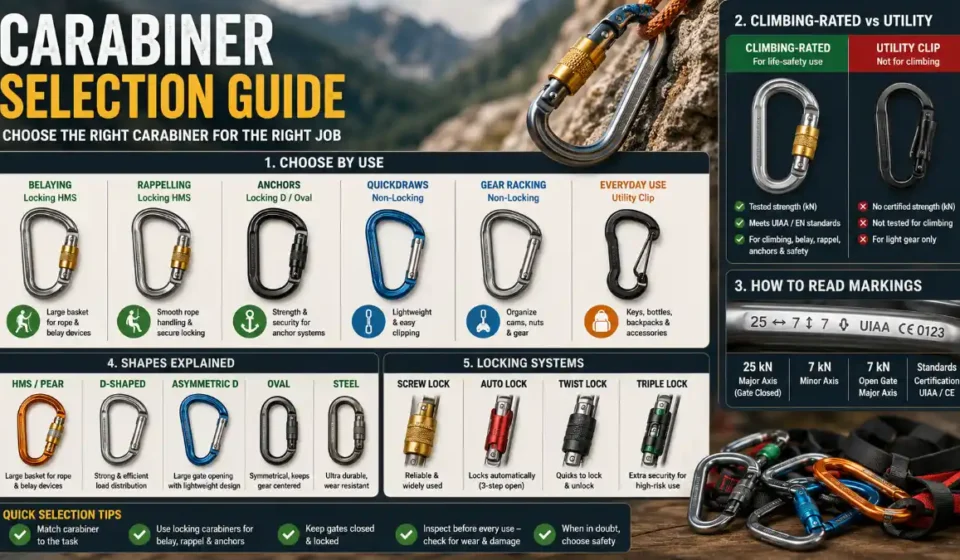

Choosing a carabiner starts with the job you need it to do. A climbing connector used for belaying, rappelling, or an anchor must be specifically designed and appropriately certified for that application, while a simple carabiner clip can be perfectly adequate for keys, bottles, and backpack organization. The important distinction is not appearance but intended use, markings, strength, compatibility, and condition.
This guide explains carabiner types, shapes, gate designs, locking systems, strength ratings,s and everyday uses so you can choose the right connector without confusing climbing hardware with an accessory clip.
First, decide what the Carabiner Is For
The easiest way to choose the right connector is to identify the task before comparing shapes or locking mechanisms.
| Intended use | Suitable starting point | What to avoid |
| Belaying | Climbing-rated locking connector compatible with the belay device | Utility clips or keychain models |
| Rappelling | Appropriate climbing-rated locking connector | Unmarked accessory hardware |
| Anchors | Suitable locking connector for the specific system | Poorly oriented or cross-loaded connectors |
| Quickdraws | Purpose-built climbing quickdraws | General-purpose clips |
| Racking cams and nuts | Climbing-rated non-locking connector | Utility clips |
| Backpack organization | Utility carabiner clip | Treating it as life-safety equipment |
| Keys | Carabiner keychain | Using it for climbing or load-bearing applications |
Read More: Carabiner
The same basic shape can appear in very different products, so a connector should never be selected solely because it looks strong or resembles climbing equipment.
For climbing, mountaineering, and other safety-critical applications, follow the manufacturer’s instructions and use equipment intended for that activity. UIAA maintains a certified-equipment database for climbing and mountaineering products, while its connector standard is UIAA 121.
How to Identify a Climbing-Rated Connector
A climbing carabiner should have meaningful technical markings rather than only a generic carrying-capacity claim. Strength is normally expressed in kilonewtons, or kN, and the body should provide identifiable strength information and manufacturer or product information.
EN 12275 is the European standard covering connectors for mountaineering, including climbing, while UIAA 121 covers climbing connectors under the UIAA safety system. The applicable certification depends on the product and intended use, so check the actual manufacturer’s documentation rather than assuming that every metal clip is climbing equipment.
Before using a connector for climbing, check for:
- Clear strength markings
- Manufacturer and product identification
- Applicable certification or conformity information
- A gate that closes correctly
- A locking mechanism that operates as intended when fitted
- No cracks, deformation, serious corrosion, or damaging wear
- Manufacturer instructions that support the intended application
A product described only as “heavy duty” is not automatically suitable for climbing. Likewise, a high load number printed on a utility clip should not be treated as equivalent to climbing certification.
Carabiner Types and Shapes
Shape affects how a connector handles rope, equipment, and load direction. The main climbing shapes include HMS or pear-shaped designs, D-shaped designs, asymmetric D models,s and oval connectors.
HMS or Pear-Shaped
An HMS, or pear-shaped, connector has a relatively large upper basket. That space makes it useful with many belay devices and rope-management applications.
A locking HMS is often a practical choice for climbers who want a connector for belaying or rappelling, provided it is compatible with the device being used. Its larger basket can also make rope handling easier than with a small, compact locker.
D-Shaped
A D-shaped connector generally directs loading toward the spine, which is the stronger side of the frame when the connector is loaded correctly.
D-shaped models are available in both locking and non-locking versions. They can work well for a variety of climbing connections, but the exact choice should still depend on the device, attachment point, and manufacturer’s instructions.
Asymmetric D
An asymmetric D is a modified D shape that combines a relatively large gate opening with an efficient frame. These connectors are common on quickdraws and lightweight climbing racks.
They can provide a useful balance between weight, gate clearance, and handling. However, shape alone does not prevent poor loading. A connector can still rotate or become cross-loaded if the surrounding system allows it.
Oval
Oval connectors have a more symmetrical shape that can help keep equipment centered. They are particularly useful in some aid-climbing and gear-management applications.
An oval is not automatically better or stronger than a D-shaped model. Its advantage is mainly the way it organizes and aligns equipment.
Locking vs. Non-Locking Carabiners
A locking mechanism is useful when unintended gate opening could create a serious problem. It does not make every connection safer automatically, however, and non-locking connectors remain essential for many climbing systems.
Quickdraws, for example, commonly use non-locking connectors because they need to be clipped rapidly to protection and rope. Critical connections such as many belay and rappel applications commonly use locking designs when appropriate.
The right question is not simply “locking or non-locking?” Ask what the connector is supposed to do and what the consequences would be if the gate opened.
Screw-Lock
A screw-lock uses a manually operated sleeve that covers the gate when locked.
Its main advantage is simplicity. The climber can deliberately close the gate and visually check the sleeve. Its limitation is equally straightforward: the user has to remember to lock it and verify that it remains locked.
Twist-Lock and Auto-Locking
Auto-locking connectors use mechanisms that automatically secure the gate after the required opening action is released. Different models may require different combinations of twisting, pushing, or other movements.
These systems can be convenient when a connector is opened frequently, but convenience does not eliminate the need for inspection and proper operation. Learn the specific mechanism before relying on it.
Double- and Triple-Action Locking
Some connectors require two or three deliberate actions to open. These mechanisms can add resistance to accidental opening, but they also require more familiarization and dexterity.
There is no universally best locking system. The best option is one that is appropriate for the application and that the user can operate and verify consistently.
Gate Styles Explained
The gate affects clipping, handling,g and the way the connector interacts with rope and protection.
Straight Gate
Straight-gate designs are common on many climbing connectors and quickdraws. They provide straightforward clipping and are useful for racking and protection depending on the model.
Bent Gate
Bent-gate connectors are frequently used on the rope-clipping end of quickdraws. The curved profile can make rope clipping easier and faster.
The important point is that a bent gate is a gate design, not a certification category. Its suitability depends on the complete connector and intended application.
Wiregate
Wiregate designs replace a conventional solid gate with a wire construction. They are popular in sport, trad, and alpine climbing because they can offer low weight and useful handling characteristics.
Wiregate connectors can be fully climbing-rated. Gate construction alone does not determine whether a connector is suitable for climbing.
Keylock Nose
A keylock nose uses a smoother gate-to-frame interface that can reduce snagging when clipping or removing equipment.
“Keylock” should not be confused with “locking.” A keylock nose can be found on a non-locking connector. Locking refers to the mechanism that prevents the gate from opening unintentionally.
How to Read Carabiner Strength Ratings
One of the most important parts of selecting climbing hardware is understanding its markings.
Climbing connectors commonly show strength values for different loading conditions:
| Marking | What it represents |
| Major axis, gate closed | Strength when loaded along the primary axis with the gate closed |
| Minor axis | Strength when loaded across the frame |
| Gate open | Strength with the gate open |
Read More: Carabiner
The major-axis rating is normally the highest of these values. The minor-axis and gate-open ratings are lower because the connector is not being loaded in its strongest configuration.
For example, a certified connector can have separate values for major-axis, minor-axis, and open-gate strength. A current UIAA-certified connector listing illustrates this format with separate 24 kN, 8 kN, and 7 kN ratings.
These numbers should not be converted into a simple “maximum body weight” figure. A climbing connector is part of a larger system, and actual forces depend on factors such as loading direction, rope behavior, equipment configuration,n and impact conditions.
What kN Means
A kilonewton is a unit of force. The kN markings on climbing hardware describe tested strength under specified conditions; they are not a direct statement of how many kilograms a person can safely hang from the connector.
This distinction matters because a person weighing a particular amount does not create only an equivalent static force in every climbing situation. Dynamic loading can produce substantially different forces.
Why Cross-Loading Matters
Cross-loading occurs when a connector is loaded across its minor axis rather than correctly along its major axis.
This can happen when:
- A belay device pulls the connector sideways
- A sling or tether rotates the connector
- Several components crowd the basket
- The connector rests against another piece of hardware
- The connector contacts an unsuitable edge or surface
- The system allows the connector to rotate into a poor position
A locking sleeve does not eliminate cross-loading. It can help keep the gate closed, but it cannot change the direction of force through the frame.
For safety-critical applications, the connector should be positioned so that the intended loading direction is maintained. Some equipment and accessories are specifically designed to help keep connectors correctly oriented. Manufacturers may provide additional features or instructions for reducing rotation and unwanted loading.
Aluminum vs. Steel
Material is another factor, but it should never be considered in isolation.
Aluminum is widely used for personal climbing equipment because it offers low weight. This matters when a climber carries many connectors on a rack or travels over long routes.
Steel is heavier and is often selected for applications where durability and repeated wear are more important than minimizing carried weight.
The key distinction is that material does not establish suitability by itself. A steel utility hook is not automatically climbing-rated, and an aluminum climbing connector is not automatically suitable for every industrial or high-wear application.
Always start with intended use, certification, strength markings, and manufacturer instructions.
Read More: Carabiner
How to Choose the Right Connector for Different Activities
Different climbing tasks place different demands on equipment.
For Belaying
A locking HMS or another connector specifically compatible with the belay device is a common starting point. Check the belay-device manufacturer’s instructions for the required connector dimensions, shape, and compatibility.
The goal is to create a stable connection in which the device and connector remain correctly oriented.
For Rappelling
A locking connector appropriate for the rappel device and system is commonly used. Before loading the system, verify the gate and locking mechanism and make sure the connector is positioned correctly.
For Quickdraws
Quickdraws generally use non-locking connectors. Many designs combine a straighter gate on the protection end with a bent gate on the rope end to make clipping more efficient.
Do not substitute a random accessory clip for a climbing quickdraw connector.
For Racking Gear
Non-locking D-shaped, asymmetric D or oval connectors can be useful for organizing cams, nuts,s and other climbing protection. The best shape depends on how much equipment needs to fit and how easily you need to retrieve it.
For Anchors
Anchor construction is highly system-dependent. A connector should be appropriate for the particular anchor arrangement and positioned so it is not accidentally cross-loaded or exposed to damaging contact.
If you are inexperienced with anchors, learn the system from a qualified climbing instructor or other appropriate training source rather than relying on a connector-selection article alone.
Carabiner Clip vs. Climbing Connector
The phrase “carabiner clip” is often used for simple utility products, but these accessories should not be confused with climbing connectors.
A utility clip can be useful for:
- Keys
- Water bottles
- Gloves
- Small bags
- Lightweight camping accessories
- Travel organization
- Backpack accessories
A carabiner keychain is particularly convenient for carrying keys or attaching small items to a bag.
The dividing line is whether the connector forms part of a life-safety or load-bearing system. If it may support a person, arrest a fall, or become part of climbing protection, use equipment specifically designed and rated for that purpose.
Never infer climbing suitability from a product’s shape, color, thickness, or marketing language alone.
Carabiner Weight and Strength: What to Compare
When people search for a “carabiner weight rating,” they may actually be asking two different questions: how much the connector weighs, or how much force it can withstand.
Those are not the same thing.
Connector weight is usually given in grams and matters primarily when reducing the weight of a climbing rack.
Strength rating is normally expressed in kN and describes tested resistance under defined loading conditions.
A lighter connector is not automatically weaker, and a heavier connector is not automatically safer. Product design, material, geometry, certification,n and intended application all matter.
For example, manufacturer specifications for climbing connectors can provide separate weight and strength information alongside locking and certification details.
Read More: Carabiner
Buying Checklist
Before buying a connector, ask these questions:
- What is the exact job? Belaying, quickdraw clipping, racking, anchoring, and everyday organization require different products.
- Is it safety-critical? If a person could depend on it for protection, use equipment specifically designed and certified for the intended application.
- Does it need to lock? Choose the locking configuration appropriate to the system rather than assuming every critical connection needs the same design.
- Which shape fits the device? Check basket size, gate opening, and compatibility.
- How will it be loaded? The connector should be positioned to encourage major-axis loading and avoid cross-loading.
- Can you inspect it easily? You should be able to confirm the gate and locking mechanism visually and physically.
- Is the product traceable? Manufacturer and product markings are important for identifying specifications and instructions.
- Is the hardware in good condition? Do not use damaged, modified,d or seriously worn climbing equipment.
- Does the manufacturer’s documentation support your intended use? If not, choose another product.
- Are you buying climbing hardware or an accessory clip? Never assume the two categories are interchangeable.
Inspection, Care and Retirement
Inspection should be part of normal climbing-equipment use. Look for cracks, deformation, serious corrosion, sharp edges, deep grooves, damaged gates, es and unusual wear.
Open and release the gate several times. It should move smoothly and close completely. If the connector locks, verify that the locking mechanism works as designed.
Keep climbing hardware clean and dry and follow the manufacturer’s care instructions. Do not file, grind, reshape, or otherwise modify a connector to repair a problem.
Pay particular attention after unusual events. Significant impacts, fire, chemical exposure, severe corrosion,n or other damage can affect equipment integrity. When the condition of safety-critical hardware is uncertain, follow the manufacturer’s retirement guidance and do not continue using questionable equipment simply because it still appears functional.
Frequently Asked Questions
What type of carabiner should a beginner climber buy first?
For a beginner who needs a connector for belaying, a locking HMS or pear-shaped design can be a practical starting point, provided it is compatible with the belay device. The correct choice depends on the device and the manufacturer’s instructions.
Can a locking carabiner still fail if it is used incorrectly?
Yes. Locking prevents or reduces the risk of unintended gate opening, but it does not eliminate cross-loading, damaging contact, incompatible equipment, or other incorrect-use problems.
Is a wiregate carabiner strong enough for climbing?
A wiregate can be fully suitable for climbing when it is specifically designed, marked, and certified for that use. Gate style by itself does not determine strength.
Why do quickdraws often have two different gate styles?
Quickdraws commonly use a connector optimized for clipping protection on one end and another optimized for clipping the rope on the other. A bent gate is frequently used on the rope end for easier clipping.
Is a steel carabiner always stronger than an aluminum one?
No. Material alone does not determine the strength rating or intended use. Compare the actual product specifications and certification rather than assuming steel is automatically safer.
What does HMS mean on a carabiner?
HMS refers to a broad, pear-shaped connector style associated with belaying and rope handling. The shape provides useful space around the rope and belay device.
Can one locking carabiner handle every climbing task?
No single model is ideal for every application. Belay devices, anchors, tethers,s and other systems can have different compatibility and orientation requirements.
What is gate flutter?
Gate flutter is a rapid movement of the gate that can occur from impact or vibration. Correct equipment selection, orientation,n and system setup help reduce the potential for problematic gate movement
Should the gate face toward or away from the rock?
There is no universal direction that applies to every system. The important principle is to prevent the gate from being pressed or rubbed open by rock, equipment, or another component and to maintain appropriate loading.
How should climbing connectors be stored?
Keep them clean and dry and protect them from excessive heat, corrosive chemicals, and damaging contamination. Follow the manufacturer’s storage and maintenance instructions for the specific product.